Something interesting is happening in the Australian trades right now. On forums like Reddit’s r/AusElectricians, working tradies are openly asking the question: why isn’t HVAC more popular? The comments that follow paint a picture of a trade with incredible earning potential — and almost no one walking through the door.
If you’ve been thinking about a trade career, or you’re already in the industry and considering upskilling, that question deserves a serious answer. Because the honest answer reveals one of the most overlooked opportunities in Australian trades right now.
So Why Isn't HVAC More Popular?
The short version: most people just don’t know enough about it. HVAC — Heating, Ventilation, Air Conditioning and Refrigeration — doesn’t get the same career expo spotlight as electrical or plumbing. Industry body AMCA (Air Conditioning and Mechanical Contractors’ Association of Australia) has publicly noted that career promoters tend to push electrical and plumbing pathways at school events, leaving HVAC off the radar for most school leavers.
- From the Trades Community
“The trade is genuinely interesting — you’re dealing with refrigeration, electrical, airflow, controls, building management. It’s way more varied than pulling wire all day. But nobody talks about it at school.”
That invisibility problem is real. But here’s the flip side: every person who overlooks HVAC is one less competitor standing between you and a high-paying, in-demand career.
The Numbers That Should Have Your Attention
Australia is facing a serious trades skills crisis. Across the board, nearly half of all advertised trade positions go unfilled. In HVAC specifically, the gap is severe — an ageing workforce is retiring, apprenticeship completions are low, and the pipeline of new talent simply isn’t keeping up.
Meanwhile, new construction projects, government sustainability mandates, and the push toward energy-efficient buildings are driving demand for skilled HVAC technicians faster than the industry can train them. Employers are competing hard for a shrinking pool of qualified workers — which has sent wages upward.
43%
of trade job ads go unfilled across Australia
7%+
annual growth rate in the Australian HVAC industry
$3B
projected market value of the Australian HVAC sector
"In a bad economy, when it breaks it needs fixing. People will always find the money for air conditioning and refrigeration."
This is one of the trade’s most underappreciated qualities: it’s recession-resistant. Commercial businesses can’t operate without working HVAC systems. Hospitals, aged care facilities, data centres, supermarkets — all of them need climate control maintained regardless of what the economy is doing. That’s the kind of job security that’s hard to find.
What Working in HVAC Actually Looks Like
Let’s address the perception problem head-on. HVAC has a reputation for being physically demanding, and that’s fair — you’ll work at height sometimes, you’ll be in hot roof spaces occasionally, and it’s not a desk job. But compare it honestly to other trades, and the picture shifts.
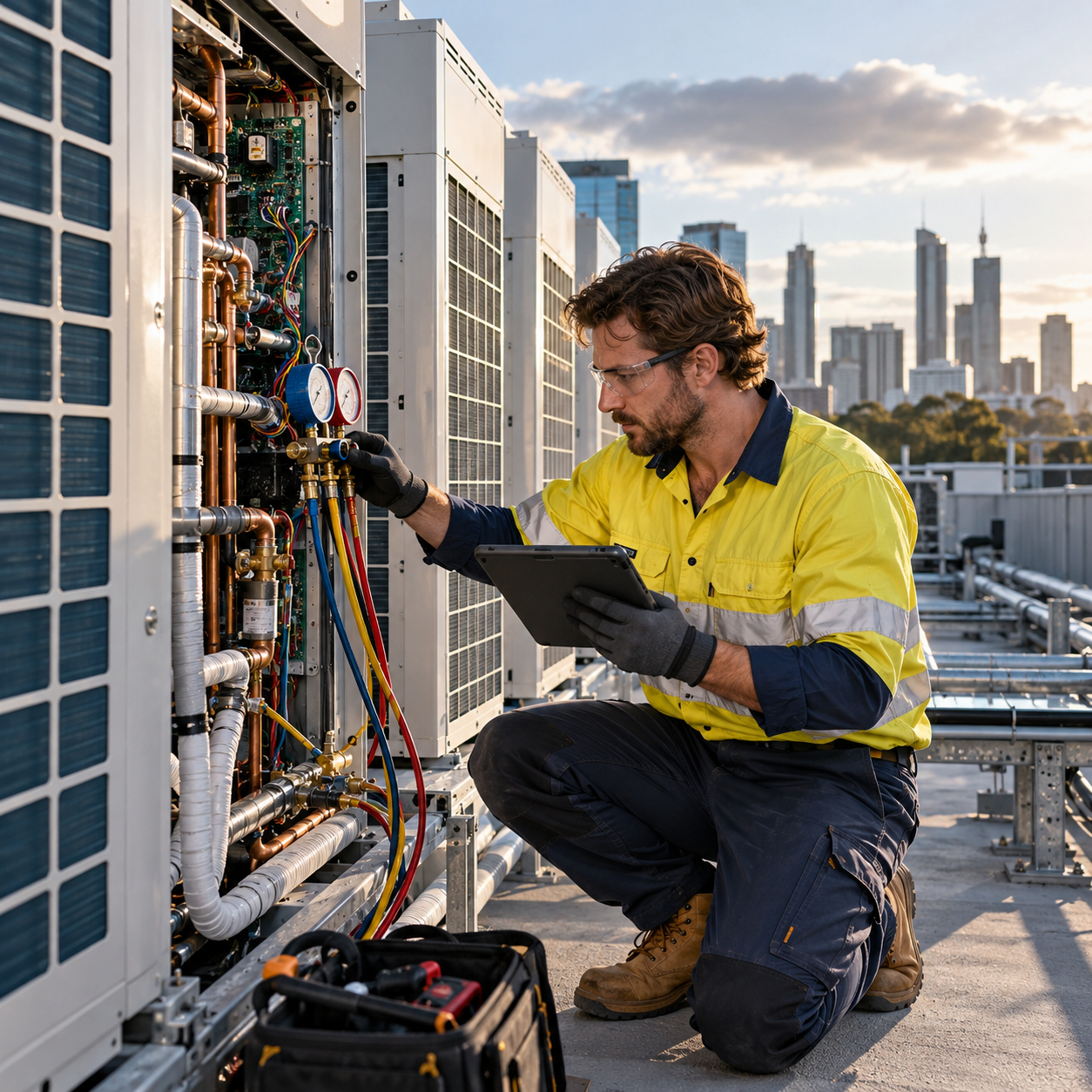
You’re not a sparky pulling wire through conduit for 8 hours. You’re not a plumber in tight, messy spaces. HVAC work is technically rich — you’re reading schematics, commissioning systems, diagnosing refrigerant issues, calibrating controls, and working with cutting-edge energy management technology. The best technicians in this trade are genuinely sought after for their diagnostic ability, not just their hands.
- Combines electrical, refrigeration, mechanical and controls knowledge — making you genuinely versatile
- Strong demand across residential, commercial, industrial, healthcare and data centre sectors
- Energy efficiency expertise is increasingly valued as buildings go green
- Heat pump and VRV/VRF technology is booming — specialist knowledge commands premium rates
- Many senior roles move into project management, consulting or running your own business
- HVAC systems require ongoing maintenance — meaning steady, recurring work (not just new builds)
What Makes HVAC Stand Out as a Trade
The One Thing Holding Most People Back: Getting Qualified
Here’s where the real barrier sits. Many people interested in HVAC assume they need to commit to a 4-year apprenticeship on low wages before they can work independently. That used to be the only path. It isn’t anymore.
The Certificate III in Air Conditioning and Refrigeration is the nationally recognised qualification you need to get licensed and work as a professional HVAC technician in Australia. It covers everything: selecting and installing systems, fault-finding, maintenance, refrigerant handling, and compliance.
What’s changed is how you get there.
What Makes HVAC Stand Out as a Trade
Book a free 15-minute consultation with an ATT Student Consultant.
Fast-Track vs. Traditional Apprenticeship: What's the Difference?
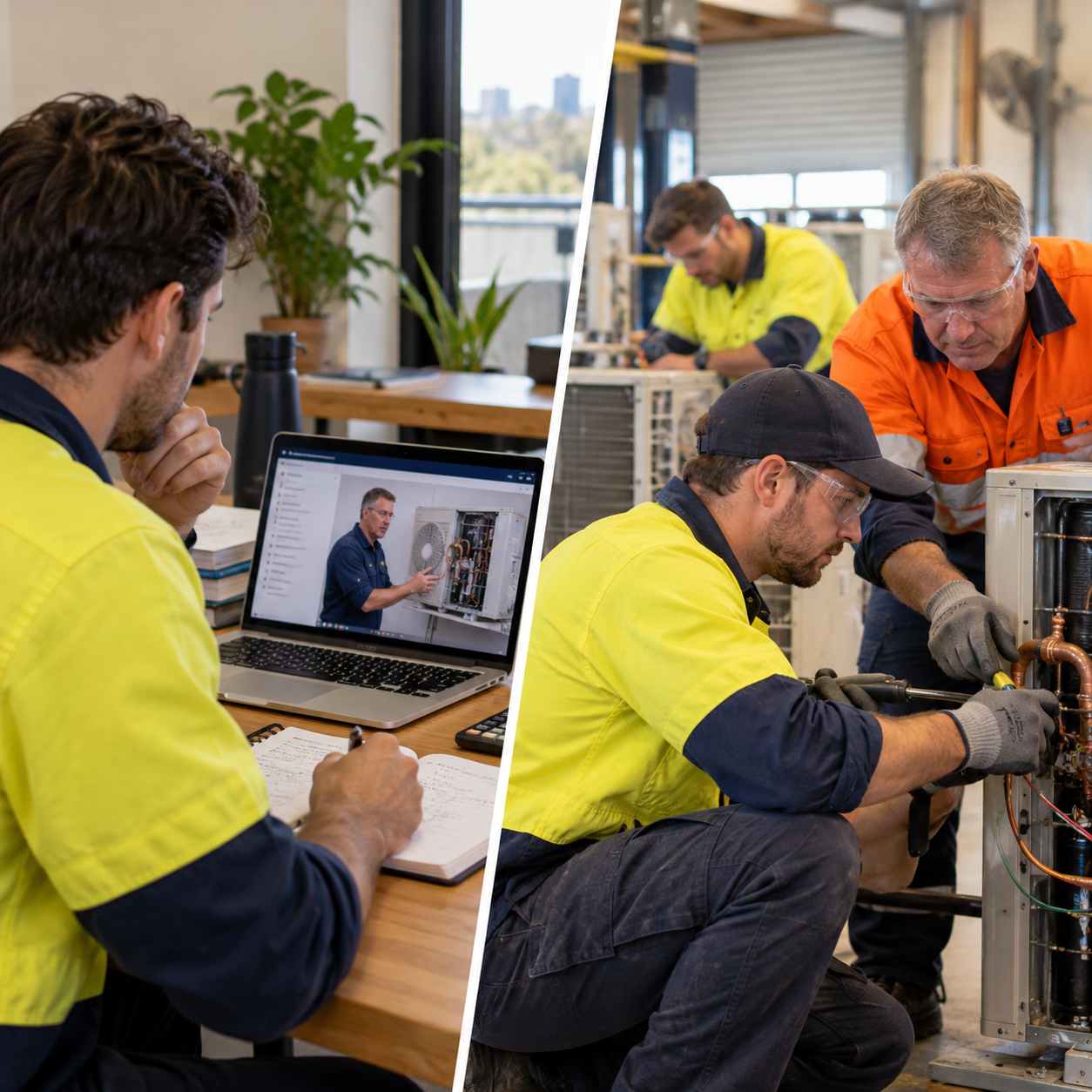
Alpha Technical Training offers a fast-track pathway to the same nationally accredited Certificate III in Air Conditioning and Refrigeration — the same qualification you’d get through TAFE, but structured around your life rather than forcing you to put it on hold.

What Matters
Traditional Apprenticeship
Fast-Track with ATT
Time to Qualify
~4 years
6–18 months
Earnings During Training
~$30k–$40k/yr apprentice wages
Keep your current income
Completion Rates
~50% nationally
94% completion rate
Licensing success
Varies
100% licensing success rate
Learning format
Fixed timetable, employer-dependent
Flexible online + monthly workshops
Outcome
Same nationally recognised cert
Same cert, 2–3 years earlier
The financial case is straightforward. Four years of apprentice wages at $35,000 per year means roughly $140,000 earned over the whole training period. Fast-track and get qualified in 12–18 months while keeping your current income, then step into a certified technician role earning $80,000–$130,000 per year. The income gap you close is significant.
And that’s before you factor in what it costs to be the least qualified person in the room for four years — limited job choices, limited autonomy, limited ability to build your own client base.
Who Is the Fast-Track Path For?
ATT’s program is built for two types of people. First, experienced technicians already working in air conditioning or refrigeration who have real-world skills but haven’t formalised them — the RPL (Recognition of Prior Learning) process means your experience actually counts toward your qualification. Second, motivated career starters who want to enter a high-demand trade without sacrificing four years of their life on low wages.
If you’re currently in a different trade and thinking HVAC might be a better fit, this is worth a conversation. The breadth of skills that transfer across is often surprising.
Ready to Get Into Australia's Most In-Demand Trade?
The Bottom Line
The Reddit thread that inspired this article didn’t reach a pessimistic conclusion. The tradies commenting on why HVAC is overlooked weren’t warning people away — they were genuinely puzzled that more people hadn’t figured out what they already knew. This is a technically rewarding, financially strong, recession-resilient trade with a gaping skills shortage and a fast-growing market.
The question isn’t really “why is HVAC unpopular?” The better question is: now that you know, what are you going to do about it?
Call us on 1300 614 292 or book your free eligibility assessment at floralwhite-toad-800621.hostingersite.com. Get qualified faster than you thought possible — and start earning what you’re actually worth.