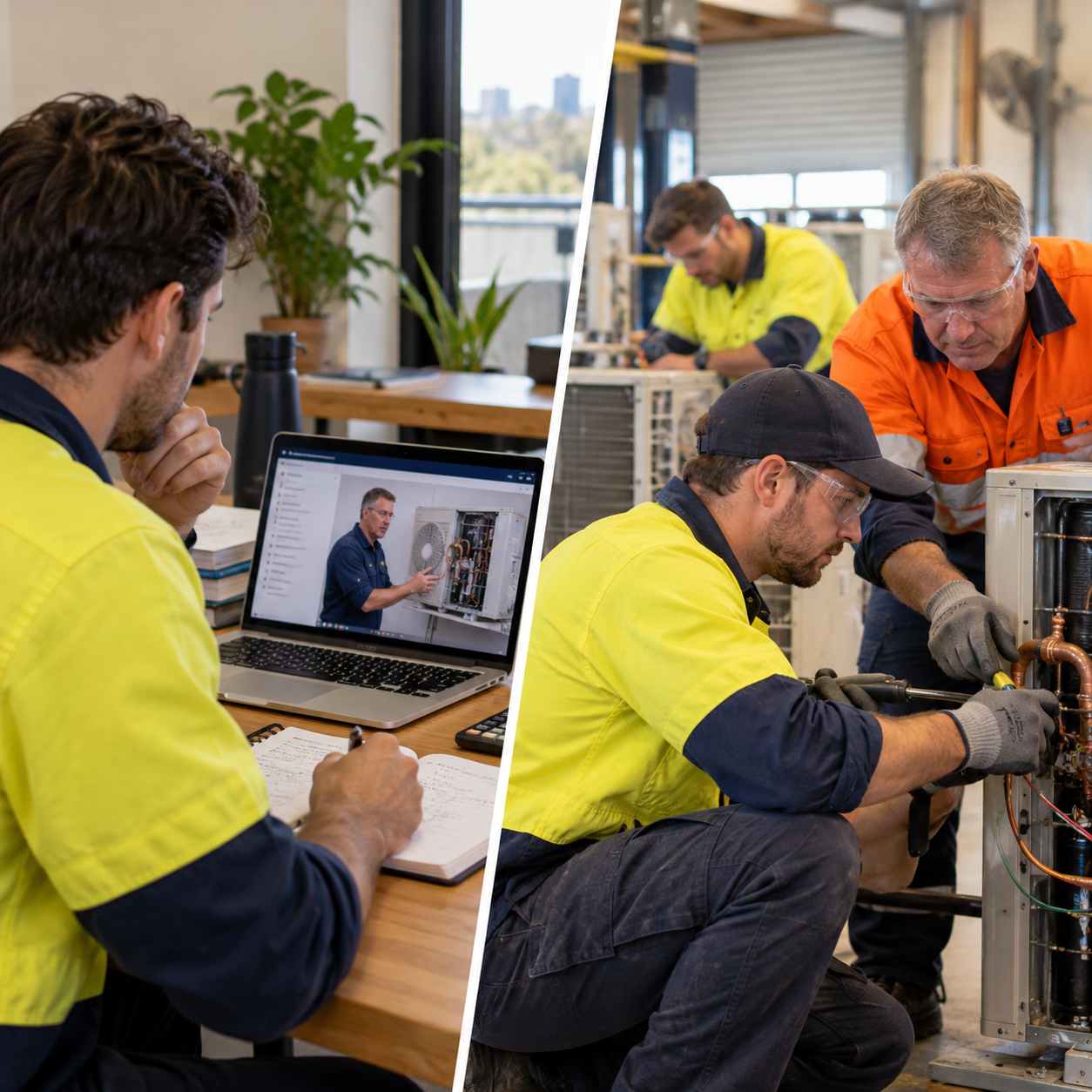
You can see the skilled trade shortage Australia-wide without opening a report. Jobs stay vacant for months. Good operators get poached fast. Employers are paying more for qualified people because unqualified labour cannot sign off work, pull in the same rates, or help a business meet licensing and compliance requirements.
For working tradies, this is not just an industry problem. It is a career window. When demand rises and qualified supply stays tight, the gap between being experienced and being properly certified gets expensive. The people who move first usually get the better jobs, stronger pay rises and more control over where they work next.
Why the skilled trade shortage Australia is feeling so sharply
The shortage is not happening for one reason. It is a stack of pressures hitting at once.
A big part of it is simple demographics. A large group of experienced tradespeople is ageing out of the workforce, and not enough new qualified workers are replacing them quickly enough. Traditional training pipelines take time, and for many adults they are not realistic. If you have a mortgage, kids, rent, or full-time work, stepping back into a long apprenticeship can feel like going backwards financially.
There is also the licensing issue. In many trades, especially technical areas like air conditioning and refrigeration, experience alone is not enough. Employers need workers who can meet regulated standards, complete compliant work, and move toward licensing. That narrows the field. A business might have plenty of hands available, but far fewer people who are job-ready on paper and in practice.
Construction demand, infrastructure work, maintenance backlogs and growing demand for energy-efficient systems have added pressure as well. Air conditioning and refrigeration is a clear example. More installations, more servicing, more compliance expectations, and more specialized equipment all mean businesses need qualified technicians who can do the work properly and legally.
What the shortage really means for tradies
When people hear about skills shortages, they often think only from the employer side. But for workers, the shortage changes the maths.
If you are already doing trade-related work but you are not formally qualified, you may be leaving money on the table every week. Employers generally pay a premium for workers who can take on more responsibility, satisfy audit and compliance requirements, and progress toward licensed roles. The same person with the same work ethic can be worth substantially more once their qualification catches up with their experience.
That does not mean every trade or every region is identical. Metro and regional demand can shift. Some sectors surge faster than others. But the broad pattern is clear – qualified tradies have more leverage than underqualified ones.
This matters even more if your long-term goal is to work independently, contract directly, or build a business. At some point, experience without credentials becomes a ceiling. You can stay busy and still stay boxed in.
The biggest bottleneck is not interest – it is access
Australia does not have a shortage of people willing to work. It has a shortage of people who can fit compliant training around adult life and finish.
That is where many traditional pathways lose otherwise capable workers. A mature-age tradie with site experience often does not need to be treated like a school leaver, but the structure of old training models can force exactly that. Long timelines, inflexible attendance, lower earnings while training and limited support all create drop-off.
For someone supporting a family, speed matters. Flexibility matters. Clear progress matters. If a qualification pathway takes too long or cuts income too hard, plenty of people simply do not start, or they start and stall.
That is one reason accelerated, structured training has become more relevant. Not because standards should be lowered – they should not – but because capable adults need a faster route through the same nationally recognised requirements.
Why air conditioning and refrigeration stands out
Some trades are under pressure. Air conditioning and refrigeration is under pressure and under the microscope.
The work is technical, regulated and tied to safety, environmental and licensing obligations. You are not just swapping parts and moving on. You are working in a field where correct procedures, compliant handling and recognised competency matter. That makes qualified technicians harder to replace and more valuable once they are in the market.
It also creates a sharper divide between people who are helping on jobs and people who are formally positioned to progress. If you are already active in mechanical services, electrical support work, HVAC assistance or related site roles, getting properly qualified can change your earning capacity faster than waiting years for opportunities to slowly open up.
That is why training providers that focus on accelerated trade outcomes have gained traction. Alpha Technical Training, for example, has built its model around a simple reality: adults do not need more delay. They need accredited training delivered in a way that works around employment and family commitments, with practical workshops, LMS tracking and support that keeps them moving toward qualification and licensing.
Qualification speed matters, but only if compliance stays intact
There is a right way and a wrong way to talk about speed.
Fast training sounds attractive, but speed without compliance is useless. If the training is not nationally recognised, if practical competency is weak, or if the pathway does not hold up when licensing requirements are assessed, you have not saved time. You have lost it.
That is why serious students should look past marketing claims and ask better questions. Is the qualification nationally recognised? How is practical training delivered? How is progress tracked? What support exists when students hit delays? Is there a clear pathway toward the relevant licensing steps where applicable?
The strongest accelerated models do not remove standards. They remove wasted time. That distinction matters.
How to turn a shortage into a career advantage
The skilled trade shortage Australia is dealing with will reward people who act with intent, not people who wait for the market to carry them.
If you are already in the industry, start by assessing the gap between the work you do now and the qualification you need to move up. For some, that gap is smaller than they think. The issue is not lack of ability. It is lack of a structured pathway.
Then look at return on investment. A qualification is not just a course cost. It is the difference between your current earning ceiling and your next one. It is access to better roles, stronger job security and, in many cases, a clearer path to licensing. When viewed over even one to three years, the cost of staying unqualified can be higher than the cost of getting it sorted.
It is also worth being honest about what will make you actually finish. A provider can have the right accreditation, but if the delivery model does not fit your life, completion becomes harder. Blended learning, practical intensives, visible milestones and real support are not nice extras for adult learners. They are often the reason the qualification gets done.
What employers are really buying when they hire qualified tradies
From the outside, it can look like employers are just paying for labour. In reality, they are paying for reduced risk and increased capacity.
A qualified worker can help a business take on more jobs with confidence. They are easier to place, easier to trust with regulated work and more likely to support long-term growth. That is why qualification affects wages even when two workers seem similarly experienced on the surface.
The same logic applies if you want to work for yourself one day. Clients, contractors and regulators do not pay extra for potential. They pay for capability backed by recognised credentials.
The shortage will not fix your career for you
Labour shortages create opportunity, but they do not automatically create progress. Plenty of tradies stay stuck in assistant roles, lower pay bands or limited job scopes because they assume experience alone will eventually get them there.
Sometimes it does. Often it does not. And when the market is moving, delay has a cost. Another year without the right qualification can mean another year of lower rates, fewer options and slower career growth.
The better move is to use this market for what it is – leverage. Demand is high. Qualified supply is tight. If you have already built real-world experience, now is the time to convert that into a recognised outcome that lifts your value.
The shortage will keep making headlines, but the real question is simpler: when demand is this strong, how much longer can you afford to stay underqualified?