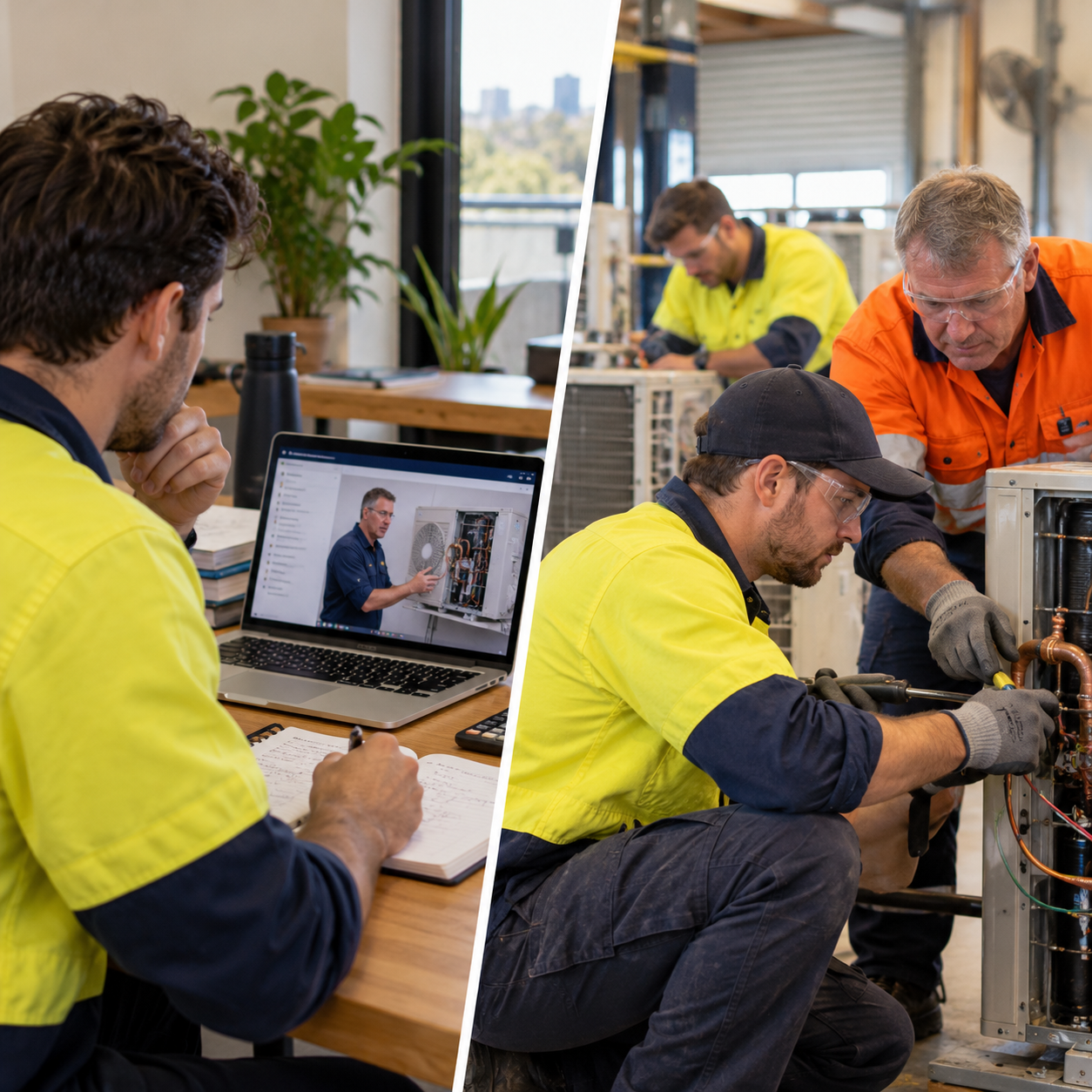
A stalled qualification pathway costs more than study time. It can keep capable tradies in the same role, limit the work they can take on and delay the confidence that comes from having recognised skills behind them. That is why online training versus workshops is not simply a question of convenience. It is a decision about how you build real capability while keeping your job, family and income moving.
For electrical, air conditioning, refrigeration and construction trades, the strongest answer is rarely one or the other. Online learning gives you control over the theory. Practical workshops prove you can apply it safely, accurately and under observation. A blended pathway brings both together without forcing working adults back into a full-time classroom routine.
Online Training Versus Workshops: Start With the Job
Trade work is practical by nature. You do not become competent at diagnosing a fault, selecting the right tools or completing a task to standard by watching a few videos on a mobile. At the same time, spending workshop hours reading material you could complete from home is an inefficient use of your time.
The right delivery method depends on what you need to learn at that point in your pathway. Knowledge can often be studied independently. Practical performance must be demonstrated in a properly structured environment with the right equipment, processes and assessor oversight.
This distinction matters for experienced workers in particular. If you have spent years on site, you may already understand the rhythm of the work. What you need is a clear way to connect that experience with structured learning, complete the required evidence and demonstrate your skills properly. If you are newer to the trade, the same blend gives you room to absorb the theory before stepping into a practical session ready to use it.
Where Online Training Delivers Real Value
Online study works best when the task is knowledge-heavy and can be completed in focused blocks around your roster. That includes technical principles, equipment terminology, calculations, safety processes, job documentation and the theory that sits behind practical decisions.
For a working tradie, flexibility is the major advantage. You can complete structured learning after work, on a day off or in the gap between jobs. You can revisit a module when a concept needs another pass rather than trying to absorb everything in a single classroom session. That matters when you are balancing site demands, family commitments and the pressure to keep earning.
A quality online learning management system should do more than hold PDFs. It should provide a clear sequence of units, checkpoints, learning resources and visibility over what comes next. The goal is not to leave you alone with content. The goal is to make progress measurable so you always know what is complete and what still needs attention.
Online learning also helps workshops run better. When learners arrive with the core theory already covered, workshop time can focus on the work that genuinely needs hands-on attention. Less time is spent on basic explanation. More time is spent applying procedures, asking targeted questions and correcting technique.
The limits of online-only delivery
Online training has a hard limit in technical trades: understanding a process is not the same as performing it. Reading about test equipment does not show whether you can use it correctly. Watching a demonstration does not prove you can follow a sequence under real conditions. Completing a quiz does not replace practical observation.
If a provider presents online learning as the whole answer for a hands-on trade outcome, ask how practical competence is assessed. The answer should be specific, structured and easy to understand. Vague promises create problems later, particularly when your goal is a nationally recognised qualification that must stand up to workplace expectations.
What Practical Workshops Do Better
Workshops are where theory becomes visible skill. They give you access to equipment, practical scenarios and trainers who can see what you are doing in real time. That immediate feedback is valuable. A trainer can identify an unsafe habit, a missed step or a misunderstanding before it becomes ingrained.
For many adult learners, practical workshops also build confidence quickly. You may know the theory on paper, but confidence grows when you complete the task yourself, explain your decisions and repeat the process until it is consistent. In a well-run workshop, assessment is not a surprise at the end. It is supported by practice, feedback and clear expectations throughout.
Workshops are particularly important when competence depends on physical accuracy, sequencing, fault finding or safe use of tools and equipment. These are not areas where shortcuts serve the learner. A faster pathway should remove wasted time, not remove the practical standard.
The limits of workshop-only training
Workshops are powerful, but they are not always efficient as the sole delivery method. Fixed attendance days can be difficult around full-time work. Travel takes time. And when every piece of theory is delivered face-to-face, learners can spend valuable practical hours covering content they could have completed independently.
There is another issue: arriving unprepared. A workshop is far more productive when you already understand the concepts, terminology and task sequence. Without that preparation, the day can feel rushed and overwhelming. You are trying to learn the background and perform the task at the same time.
Why Blended Learning Is the Stronger Pathway
Blended learning combines self-paced online theory with planned hands-on workshops. It is designed for people who need flexibility without sacrificing practical training quality.
The sequence is straightforward. Complete the theory in manageable blocks. Work through any knowledge gaps with support. Attend workshops ready to apply the material. Receive feedback from active industry professionals. Then continue progressing through the next stage with a clear plan.
That structure is especially effective for tradies who cannot put work on hold. Instead of choosing between earning and studying, you can organise study around your existing responsibilities while still committing to scheduled practical milestones. You remain accountable, but the pathway works with the reality of adult life rather than ignoring it.
At Alpha Technical Training, this approach is built around structured online learning and practical workshops because both parts have a job to do. The online component creates flexibility and momentum. The workshop component develops and verifies practical capability. Together, they give working adults a more direct route to recognised trade outcomes.
Choose Based on Your Starting Point
If you already have solid site experience
You may not need to spend months sitting in a traditional classroom repeating concepts you use every day. But experience should not be treated as an automatic substitute for formal assessment. The best pathway identifies what you already know, shows you what evidence is required and focuses your time on the remaining gaps.
Look for training that respects your experience while maintaining clear standards. You want progress that is efficient, not assumptions that leave you exposed when practical assessment begins.
If you are early in your trade career
You will usually benefit from a stronger rhythm between online learning and workshops. Complete the theory first, then attend practical training to see how each concept works on the tools. Repetition matters. So does access to trainers who can explain not just what to do, but why the sequence matters.
Do not mistake flexibility for a lack of structure. Early-career learners need a defined plan, regular milestones and practical sessions that build skill in the right order.
If your roster changes every week
Online learning can keep your pathway alive when site hours move around. The key is setting realistic weekly targets rather than waiting for a perfect free weekend that never arrives. Even a few focused sessions can build momentum when the course is organised clearly.
You will still need to protect time for workshops. Treat those dates as professional commitments, not optional extras. They are where your preparation turns into demonstrated capability.
Questions to Ask Before You Enrol
Before committing, make sure the training model answers four practical questions. First, can you complete theory around your work commitments without losing access to trainer support? Second, are the workshops genuinely hands-on and aligned with the skills you need to demonstrate? Third, is the assessment process explained clearly from the outset? Finally, does the provider give you a realistic progress plan rather than a generic promise of speed?
The right answer will not be identical for every tradie. A worker with years of experience needs a different level of support from someone entering a technical field for the first time. What should stay consistent is the standard: flexible theory, meaningful practical training and a pathway that keeps you moving forward.
Choose the format that respects both your time and the trade. Study the theory when it suits your life, show your skills where they count, and keep building the qualification that supports the career you want next.