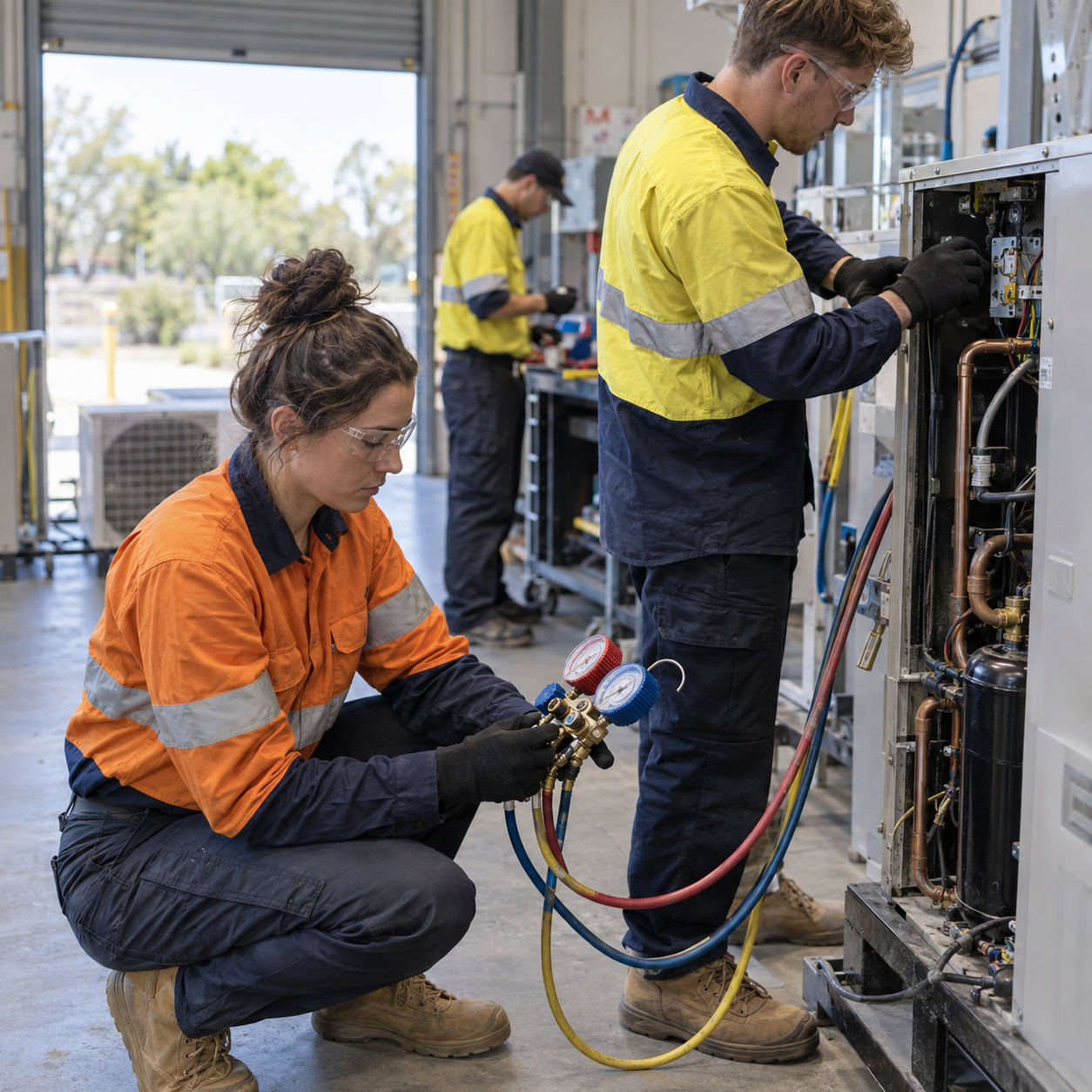
You may already be doing the work: installing systems, diagnosing faults, reading plans, managing jobs and delivering outcomes your employer relies on. The frustrating part is being held back because your experience is not yet backed by a recognised trade qualification. For many capable tradies, the real question is: can experienced workers skip apprenticeship?
The short answer is that an experienced worker may not need to start from day one or repeat skills they can already prove. But this is not a shortcut where experience is simply claimed and a certificate appears. To move faster, you need a compliant assessment pathway, strong evidence and the ability to demonstrate your competence against the requirements of the qualification.
For the right person, that can turn years of real site experience into a clear route towards becoming qualified without putting work and family life on hold.
Can experienced workers skip an apprenticeship?
In many cases, experienced workers can avoid completing a full traditional apprenticeship from scratch by pursuing recognition for skills and knowledge already gained on the job. The process is commonly referred to as Recognition of Prior Learning, or RPL.
RPL assesses what you can do now, not how long you have spent in the industry. If your current skills match the units within a nationally recognised qualification, and you can provide credible evidence and complete any required practical assessment, those capabilities may be recognised.
That distinction matters. Time served is not the same as competency. Someone may have worked in a trade environment for ten years but only carried out a narrow range of tasks. Another worker may have three years of broad, supervised experience across installation, fault finding, testing, documentation and customer handover. The second person may be in a stronger position, depending on the qualification requirements and the quality of their evidence.
A traditional apprenticeship remains a solid pathway for people entering a trade with limited experience. It gives them structured development over time. RPL is designed for the worker who has already built genuine competence and needs a formal process to have it assessed.
What an accelerated pathway actually involves
A credible accelerated pathway does not cut out assessment. It removes duplication.
You will generally begin with a skills review to identify the work you have performed, the equipment you have used and the areas where you have responsibility. From there, an assessor maps your experience against the relevant qualification requirements.
Evidence may include employment history, referee reports, job cards, photos or videos of completed work, work samples, site documentation, tickets and records of previous training. Evidence needs to be current, authentic and directly relevant. A photograph of a finished job may support your claim, but it rarely proves every part of the process. Assessors need to see that you understand safe work practices, planning, technical decisions, testing and the standards expected in the role.
Practical assessment is often the point where experienced workers can separate broad claims from proven capability. You may be asked to complete tasks in a workshop or simulated workplace environment, explain your approach and respond to technical questions. This is not there to catch you out. It is there to make sure the qualification has real value in the industry.
Where there are gaps, you do not necessarily need to abandon the fast-track route. You may complete targeted gap training, online theory or practical workshops for the specific skills you have not yet had the chance to perform. That is a far more efficient outcome than repeating every unit from the beginning.
Experience that usually puts you in a strong position
The strongest candidates have more than a job title. They can show a consistent record of carrying out the full range of work connected to their trade.
For an electrical or air conditioning and refrigeration worker, that could mean interpreting drawings, selecting and using tools correctly, installing equipment, diagnosing issues, completing testing, following safety procedures and communicating clearly with supervisors, clients and other trades. The exact requirements vary by qualification, but the principle stays the same: your experience must be broad enough, recent enough and verifiable.
Working under supervision can still count. Many experienced trade assistants and mature-age workers have developed substantial practical capability while supporting qualified tradespeople. What matters is being honest about what you personally completed, what you observed and where another worker held responsibility.
Trying to overstate your experience is a poor strategy. It creates gaps during assessment and can slow the process down. A clear, accurate picture gives the assessor the best chance to recognise what you genuinely know and build a focused plan around what remains.
The evidence problem that delays capable tradies
Most experienced workers do not lack skill. They lack organised proof.
If you have been moving from site to site for years, your evidence may be spread across old mobiles, payroll records, supervisors’ contacts, emails and photos buried in a camera roll. Start collecting it before you enrol. Create folders by job type, save relevant documents and make a list of employers, supervisors and projects that can verify your work.
Good evidence tells a complete story. It shows what task was completed, when it happened, where it was done and what your role was. It also needs to connect to the skills being assessed. Ten photos of the same split-system install are less useful than a range of evidence showing different tasks, equipment and conditions.
Referees matter as well. A supervisor who can speak specifically about your work is far more useful than someone who can only confirm you were employed. Choose people who have actually seen your technical ability, reliability and approach to safe work.
When a traditional apprenticeship may still be the better choice
Fast-tracking is not automatically the best option simply because you have experience. If your work history is limited to one narrow task, if your technical knowledge is patchy or if you cannot obtain enough evidence, a more structured training pathway may deliver a stronger result.
The same applies if you have been away from the trade for a long period. Skills, equipment and industry expectations change. A quality provider should identify this early, rather than promising a quick outcome that does not stand up to assessment.
There is also a personal factor. Some people learn best through ongoing workplace mentoring and regular training blocks. Others need flexibility because they are already working full-time, supporting a family or running a small operation. The right pathway is the one that closes your actual gaps without wasting your existing capability.
How to prepare before you start
Treat your pathway like a job you want to win. Be ready to explain your experience clearly and back it up.
Gather your résumé, employment details, training records and examples of work completed. Write down the kinds of jobs you have handled, the systems or tools you have used and the problems you have solved. Think beyond routine tasks. Assessors need visibility of the decisions you make when a job does not go to plan.
Then be prepared to demonstrate your skills. Hands-on experience is valuable, but you should also be able to explain why you take a particular approach, what checks you carry out and how you manage risk. Strong tradies do not just get the job done. They understand the standard required and can show their work is repeatable.
Alpha Technical Training supports experienced workers through flexible, blended training that combines self-paced theory, structured learning and practical workshops led by active industry professionals. The goal is not to drag capable people through unnecessary training. It is to help them prove what they already know, address what they do not and move forward with a qualification that carries weight.
Your experience has value, but it only changes your career when it can be demonstrated. Start organising the proof, be honest about the gaps and choose a pathway built to recognise real capability rather than make you repeat your past.