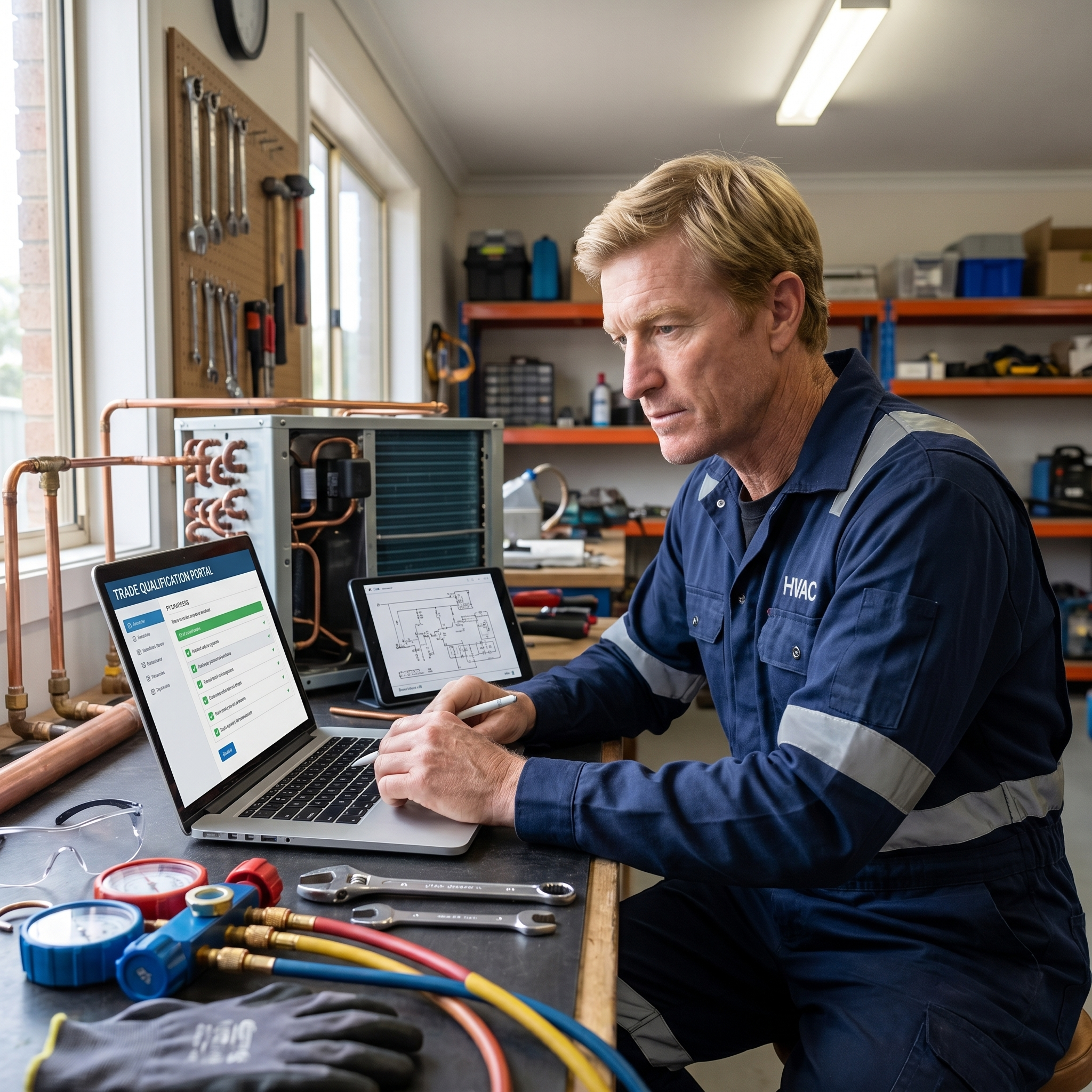
If you’re already doing trade work but still getting paid like an offsider, the gap is costing you every week. A self-paced trade qualification is built for people who can do the job, need the paperwork, and can’t afford to put life on hold for a slow, traditional pathway.
For a lot of Australian tradies, that’s the real issue. It is not whether you’re capable. It is whether you can become formally qualified without giving up full-time work, losing income, or dragging the process out for years. That is where self-paced delivery has changed the game.
What a self-paced trade qualification actually means
A self-paced trade qualification does not mean teaching yourself from scratch with no support. In a quality training model, it means you complete the theory components online at a pace that suits your schedule, while still working through an accredited course structure with clear benchmarks, trainer support, and practical assessment requirements.
That distinction matters. Flexible does not mean loose. If the qualification is nationally recognised, the compliance standard is the same whether you study through a traditional delivery model or a more accelerated blended pathway. The units, assessment requirements, and evidence standards still have to be met.
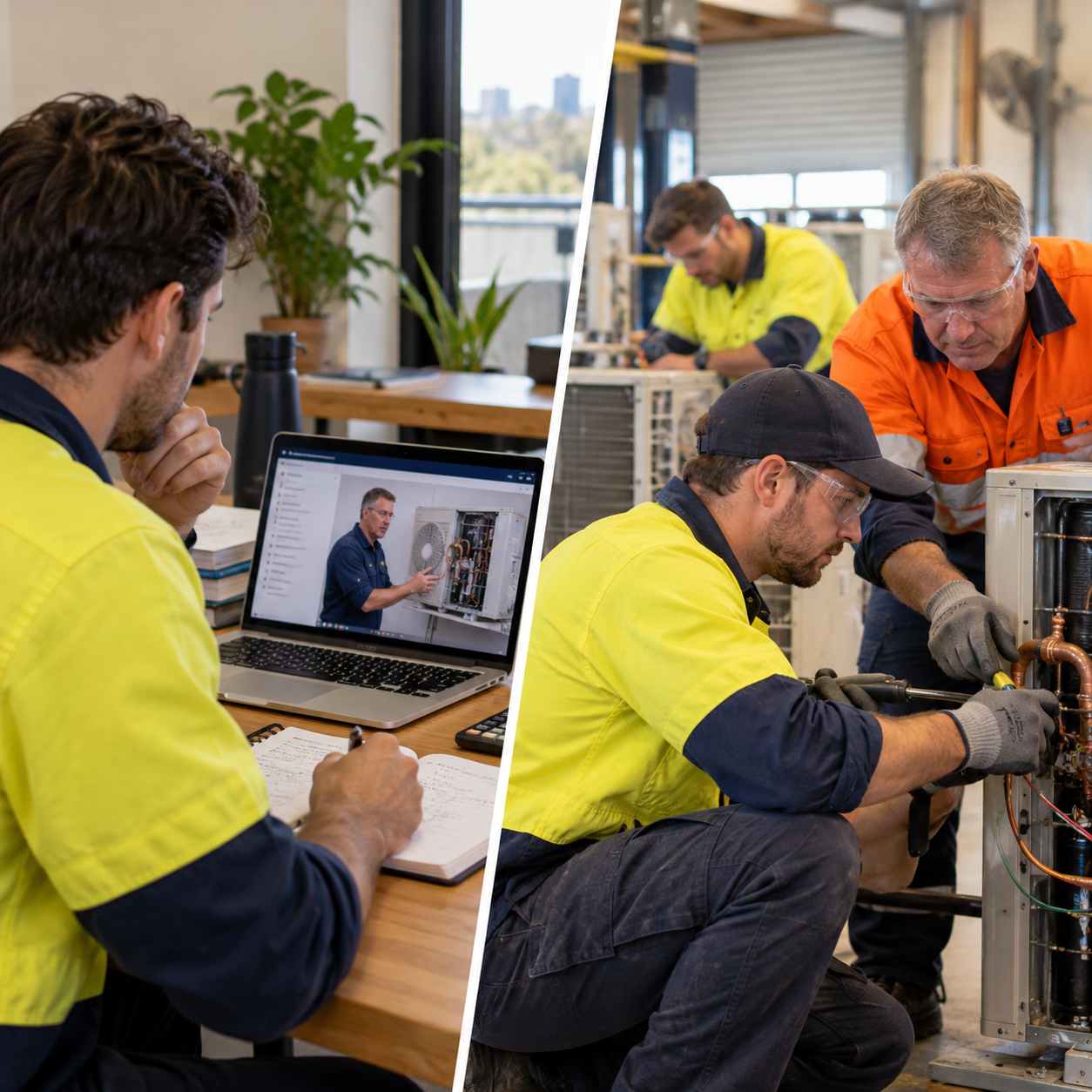
What changes is the delivery. Instead of sitting in a classroom every week or committing to a standard apprenticeship timeframe, you move through theory when you have the capacity – early mornings, nights, weekends, between jobs, whenever it works. Then you complete practical workshops and assessments in a structured way so the qualification stays grounded in real trade capability.
Why tradies are moving away from the old model
The traditional apprenticeship route still has its place, especially for school leavers starting from zero. But for adults already in the workforce, it can be a poor fit. If you’ve already built site experience, worked under supervision, or spent years in related industries, starting at the same pace as a first-year apprentice can feel like going backwards.
That is why more workers are looking at self-paced trade qualification pathways. They want recognition for what they already know, a faster route to compliance, and a clearer return on the money and time they invest.
The financial argument is hard to ignore. The longer you remain unqualified, the longer you stay locked out of higher-paid roles, licensing opportunities, and independent work. Waiting another two, three, or four years has a real cost. It affects not just wages, but job options, subcontracting opportunities, and your ability to step up into specialised work.
For sectors like air conditioning and refrigeration, formal qualifications are not just a nice-to-have. They are tied directly to licensing, legal scope of work, and employability. If you want to move beyond helping out and into fully recognised technical work, credentials matter.
Speed matters, but only if compliance stays intact
Fast-tracked training gets attention for obvious reasons. People want to qualify sooner and earn sooner. But speed on its own is meaningless if the qualification is not delivered properly.
This is where plenty of people get cautious, and rightly so. If a provider promises a shortcut with no structure, no practical rigour, or vague claims around recognition, that is a red flag. A genuine self-paced trade qualification should still be anchored in accredited training, mapped competencies, valid assessment, and real trainer oversight.
The better question is not, “Can I finish quickly?” It is, “Can I finish quickly without compromising the standard I need for licensing, employment, and long-term credibility?”
That answer depends on the provider and the model. When the online theory is supported by a proper LMS, progress tracking, trainer contact, and scheduled practical workshops, speed becomes realistic without turning the qualification into a box-ticking exercise.
Who this pathway suits best
Self-paced training works best for adults with a clear reason to move. If you’re already working in or around a trade, have some technical exposure, and need a qualification that fits around your current commitments, it can be a strong option.
It is especially useful for people who are balancing work and family responsibilities. Taking days off every week for campus attendance is not realistic for many mature-age students. A flexible structure gives you control over when you study, while still keeping you accountable to the outcome.
It also suits motivated learners who do not need hand-holding every day. That does not mean going it alone. It means you can stay disciplined, follow a plan, and keep progressing without needing a classroom timetable to force the issue.
If you struggle badly with self-management, though, self-paced delivery can become a trap. Flexibility is valuable, but only if you use it. The students who do well in this model usually have a strong reason for getting qualified and a timeline they are serious about hitting.
What to look for in a self-paced trade qualification
Not all flexible programs are built the same. Some are genuinely designed to help working tradies finish faster with proper support. Others rely too heavily on the idea of convenience and leave students to figure out the hard parts themselves.
First, check that the qualification is nationally recognised and relevant to your licensing or career goal. That sounds basic, but it is where many costly mistakes start.
Second, look at how practical skills are delivered and assessed. Trade qualifications should not live entirely on a screen. If there are no structured workshops, no observed practical tasks, and no clear evidence process, ask harder questions.
Third, look for progress visibility. A proper LMS with milestone tracking matters because momentum matters. When you can see exactly what is complete, what is outstanding, and what comes next, it is much easier to stay on track.
Fourth, ask what support exists beyond enrolment. Good training providers do not disappear once you sign up. They help with planning, trainer access, assessment guidance, and often the next step into licensing or regulator requirements.
That broader support is one of the reasons blended models are performing well. They combine flexibility with structure, which is exactly what most working adults need.
The real trade-off: freedom versus discipline
There is no perfect training model for everyone. A self-paced trade qualification gives you more control, but it also asks more from you.
The upside is obvious. You can keep earning while you study. You can work around family life. You can progress faster than a fixed timetable would allow. If you are motivated, that can compress the path to qualification significantly.
The trade-off is that no one is standing over your shoulder every day. If you put study off for a week, then another week, flexibility starts working against you. That is why the strongest providers build in checkpoints, workshops, and regular contact. Freedom works best when there is still a framework around it.
Why blended delivery is often the sweet spot
Purely online trade training sounds convenient, but trade work is practical by nature. Purely face-to-face training, on the other hand, can be too rigid for adults with jobs and mortgages.
Blended delivery usually lands in the right place. You handle theory online at your own pace, then attend practical sessions to build, demonstrate, and validate the hands-on skills. That keeps the qualification flexible enough for real life and strong enough for real industry expectations.
For trades connected to technical compliance, safety, and licensing, that balance matters even more. You need theory you can complete efficiently, but you also need practical competence that stands up on the tools.
That is why providers like Alpha Technical Training have focused on structured self-paced learning rather than loose, unsupported online study. The goal is simple: get capable people qualified faster, without lowering the standard.
Is it worth it?
If you’re comparing a self-paced trade qualification to doing nothing for another year, the answer is usually yes. Every extra month without formal credentials can limit what you earn and what work you can legally do.
If you’re comparing it to a traditional pathway, the answer depends on your situation. For school leavers who need a slow build and constant supervision, traditional delivery may still be the better fit. For working adults with industry exposure, a faster and more flexible model often makes far more sense.
The key is choosing a pathway that respects both speed and standards. You want a qualification that gets you closer to licensing, better pay, and stronger job security – not one that creates problems later because corners were cut.
If you are ready to stop being valued below your actual skill level, a self-paced trade qualification is not just a study option. It is a practical move to close the gap between the work you can do and the career you are allowed to have.
The right time is usually earlier than most people think, because the cost of waiting rarely shows up on one invoice – it shows up in the work you miss, the money you leave on the table, and the opportunities that keep going to someone already qualified.