If you are already doing air con or refrigeration work and getting blocked on jobs, there is usually one reason – licensing. A lot of tradies ask what qualifications need refrigerant licence requirements in Australia, and the answer matters because the wrong assumption can cost you work, delay your career, and create compliance risk fast.
The short version is this: if your job involves handling refrigerant, disconnecting or connecting refrigeration and air conditioning equipment, or carrying out work that could release refrigerant, you will generally need the right refrigerant handling licence. But a licence does not stand on its own. You usually need a relevant qualification, or you need to be enrolled in one, depending on the licence class and the work you are doing.
What qualifications need refrigerant licence approval?
In Australia, refrigerant licences are tied to the type of work you perform. That is the first thing to get clear. There is not one blanket licence for every person who touches an air conditioning system. Licensing is based on tasks, equipment type and whether you are installing, servicing, repairing, decommissioning or recovering refrigerant.
For most technicians working in refrigeration and air conditioning, the relevant pathway is a Refrigerant Handling Licence. To get that, you generally need a nationally recognised qualification that proves you are competent in the work covered by the licence class. In practical terms, that often means a trade qualification in air conditioning and refrigeration.
The qualification most commonly associated with full trade-level work is UEE32220 Certificate III in Air Conditioning and Refrigeration. This is the benchmark qualification for people who want to work legally and credibly across installation, service and maintenance work in the RAC industry. If your goal is to become a properly qualified fridgie, increase your earning capacity and stop missing out on restricted work, this is the qualification that puts you in the strongest position.
There are also restricted licence pathways for specific occupations. An electrician, for example, may be able to obtain a restricted refrigerant handling licence for certain disconnect and reconnect tasks on split systems, provided they complete the required units and meet the licence conditions. That is where people get caught out. They assume their existing trade licence covers refrigerant work. It does not automatically.
The qualification depends on the work you want to do
This is where the detail matters. If you want to install, commission, service and repair refrigeration and air conditioning systems as your trade, you are looking at a full qualification pathway. If you only need to disconnect and reconnect a split system as part of another licensed trade, the qualification requirement may be narrower.
That distinction matters for time, cost and career outcomes. A restricted pathway may get you legal access to a limited scope of work, but it will not give you the broader qualification needed to step into full refrigeration and air conditioning roles. If your long-term plan is better pay, more job options and the ability to work across the industry with fewer limits, going straight to a full trade qualification is usually the smarter move.
Who needs a refrigerant licence?
Anyone carrying out refrigerant handling work must take this seriously. That can include technicians who install split systems, mechanics working on vehicle air conditioning, refrigeration apprentices, service techs, and contractors recovering refrigerant during decommissioning.
The trigger is not your job title. It is the actual work being done.
If you are decanting refrigerant, charging a system, recovering gas, pressure testing in a way connected to refrigerant work, or disconnecting and reconnecting certain equipment, you are likely in licensed territory. Even if you have years of hands-on experience, experience alone is not the same as holding the correct qualification and licence.
That is one of the biggest frustrations in this trade. Plenty of capable workers can do the job but are still locked out of higher-paying roles because they are not formally qualified. The market rewards credentials. Employers want compliance. Customers want confidence. Regulators want proof.
What qualification is usually required for a full licence?
For most people entering or formalising a career in refrigeration and air conditioning, the key qualification is UEE32220 Certificate III in Air Conditioning and Refrigeration.
This qualification is designed to build competency in areas such as fault finding, installation, maintenance, electrical disconnect and reconnect, refrigerant recovery and system servicing. It is not just a box-ticking exercise. It is the evidence base that supports your licence application and your employability.
The real advantage is not just meeting the minimum standard. It is what happens after that. Once you hold the right qualification, you are in a stronger position to apply for licensing, access more specialised work, and move out of helper-level or unlicensed roles that cap your income.
That is why speed matters, but only if compliance stays intact. A faster pathway only makes sense if the training is nationally recognised, properly structured and built around the licensing outcome.
Restricted licences are not the same as full trade qualifications
A restricted refrigerant handling licence can suit workers in related trades, especially where refrigeration work is only one part of the job. For example, some electricians seek a restricted licence to legally disconnect and reconnect split systems during installation work.
That can be a good option if your scope of work is genuinely narrow. But it is not the same as becoming qualified as an air conditioning and refrigeration mechanic. It will not open the same doors, and it will not give you the same flexibility if you later want to expand your services or move into a dedicated HVACR role.
This is where a lot of tradies waste time. They choose the shortest option without thinking about where they want to be in 12 or 24 months. If you are already investing time and money into getting compliant, it pays to line that effort up with your bigger earning goal.
Why formal qualifications matter more than ever
The industry has tightened up. Employers, builders, facility managers and commercial clients are under more pressure to engage qualified, licensed workers. That means informal experience carries less weight than it used to.
A recognised qualification does three jobs at once. It supports licensing, improves your job prospects and raises your market value. It also gives you a cleaner path into subcontracting or running your own operation later on.
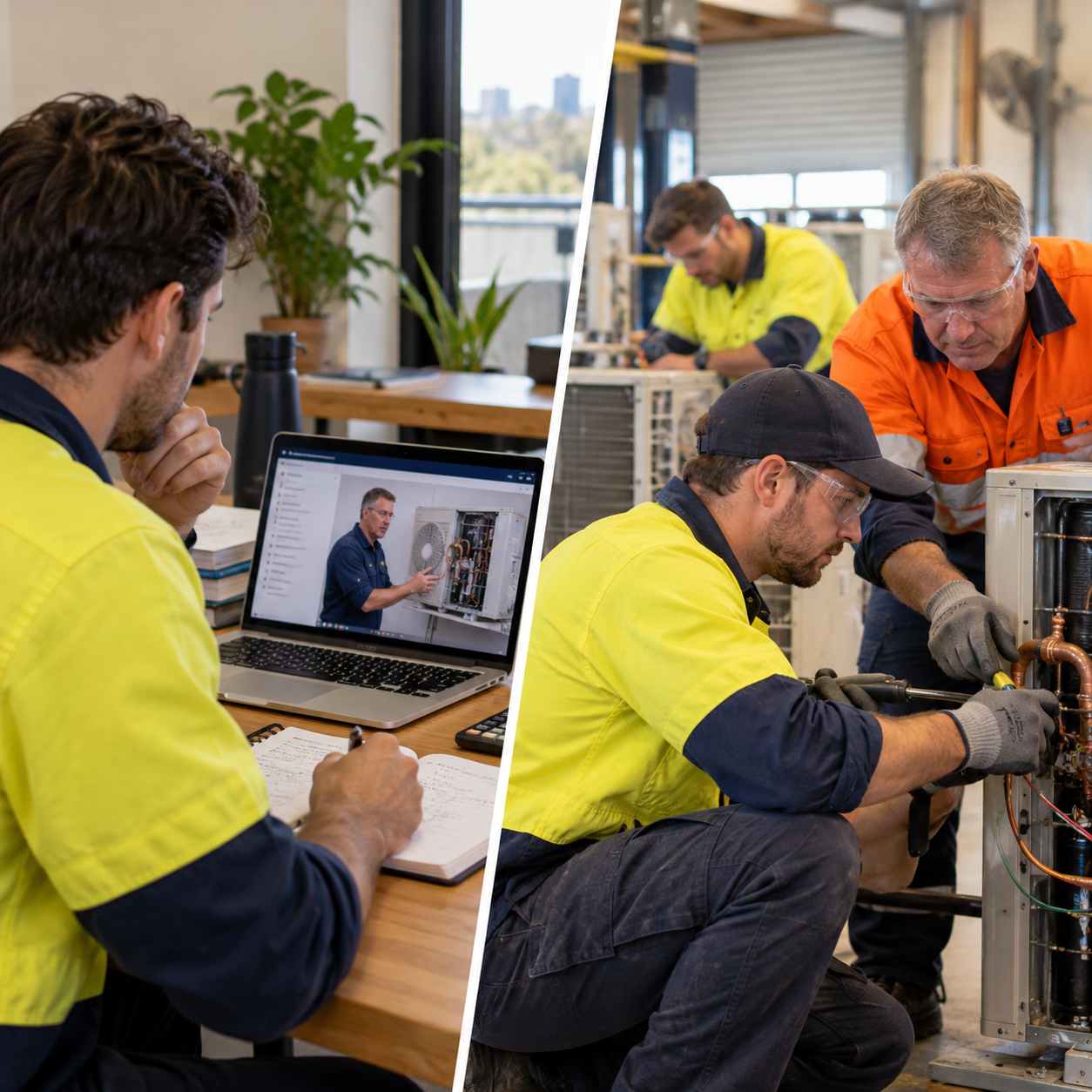
For working adults, the main barrier is rarely motivation. It is logistics. A traditional apprenticeship model can feel too slow, especially if you already have industry experience and family bills to cover. That is why accelerated, blended training has become such a strong option. You can keep working, complete theory online, attend practical workshops, and move towards the same recognised outcome without putting your life on hold.
How to choose the right qualification pathway
Start with the work you want to be legally allowed to do, not just the course that looks quickest. If your goal is broad RAC trade work, a full Certificate III pathway makes sense. If your role only requires limited split system disconnect and reconnect work, a restricted pathway may be enough.
Then look at delivery. If you are an adult learner already on the tools, flexibility is not a bonus. It is essential. The best training pathway is one that lets you keep earning while you qualify, tracks your progress clearly, and includes practical support from trainers who actually know the industry.
You also want confidence that the training aligns with licensing requirements. That sounds obvious, but too many people enrol first and ask questions later. A good provider should be able to explain exactly how the qualification supports your intended licence outcome and what extra steps may apply.
For tradies who want to move quickly without cutting corners, that is where a provider like Alpha Technical Training fits the market well – nationally recognised training, flexible structure, and a clear pathway towards qualification and licensing support.
The real cost of getting this wrong
If you work without the right qualification and licence, the risk is not theoretical. You can lose jobs, get knocked back by employers, damage your reputation and expose yourself to compliance issues that are far more expensive than proper training.
There is also the opportunity cost. Every month you stay half-qualified is another month on lower rates, narrower job options and less control over your future. For many tradies, the difference between staying stuck and moving ahead comes down to making one clear decision: get the qualification that matches the work you actually want.
If you have been asking what qualifications need refrigerant licence approval, the next question is the one that counts – do you want the minimum needed for a narrow task, or do you want the qualification that gives you room to build a better-paid career?