A lot of tradies ask the same question right before they enrol: is online trade training legitimate, or is it just a dressed-up shortcut that leaves you with a useless certificate and no real job outcome?
It is a fair question. In trades, results matter. You are not buying theory for theory’s sake. You are investing in a qualification that needs to stand up with employers, licensing bodies and on real worksites. If a training pathway cannot get you closer to compliance, better pay and recognised skills, it is not worth your time.
The short answer is yes, online trade training can be completely legitimate in Australia. But legitimacy does not come from slick marketing or a flashy learning portal. It comes from accreditation, compliance, assessment quality and practical competency. That is where the difference sits.
What makes online trade training legitimate?
Online delivery by itself is neither good nor bad. It is simply a mode of study. What matters is whether the course leads to a nationally recognised outcome, whether the training provider is authorised to deliver it, and whether the student is being properly assessed against industry standards.
If the course is part of a recognised vocational framework, the provider has the right approvals, and the training includes both theory and hands-on assessment where required, then online learning is not a compromise. It is just a more flexible way to complete the same qualification.
That matters for adult learners. Most people considering trade training online are not school leavers with spare weekdays. They are working, paying a mortgage, raising kids, covering fuel, tools and bills, and trying to move forward without stepping backwards financially. A rigid classroom schedule can be the bigger risk, because it delays completion and drags out the point where higher earnings become possible.
Is online trade training legitimate for hands-on trades?
This is where people get sceptical, and rightly so. A trade is practical. No one wants an air conditioning tech, fridgie or sparky who has only watched videos and ticked quizzes.
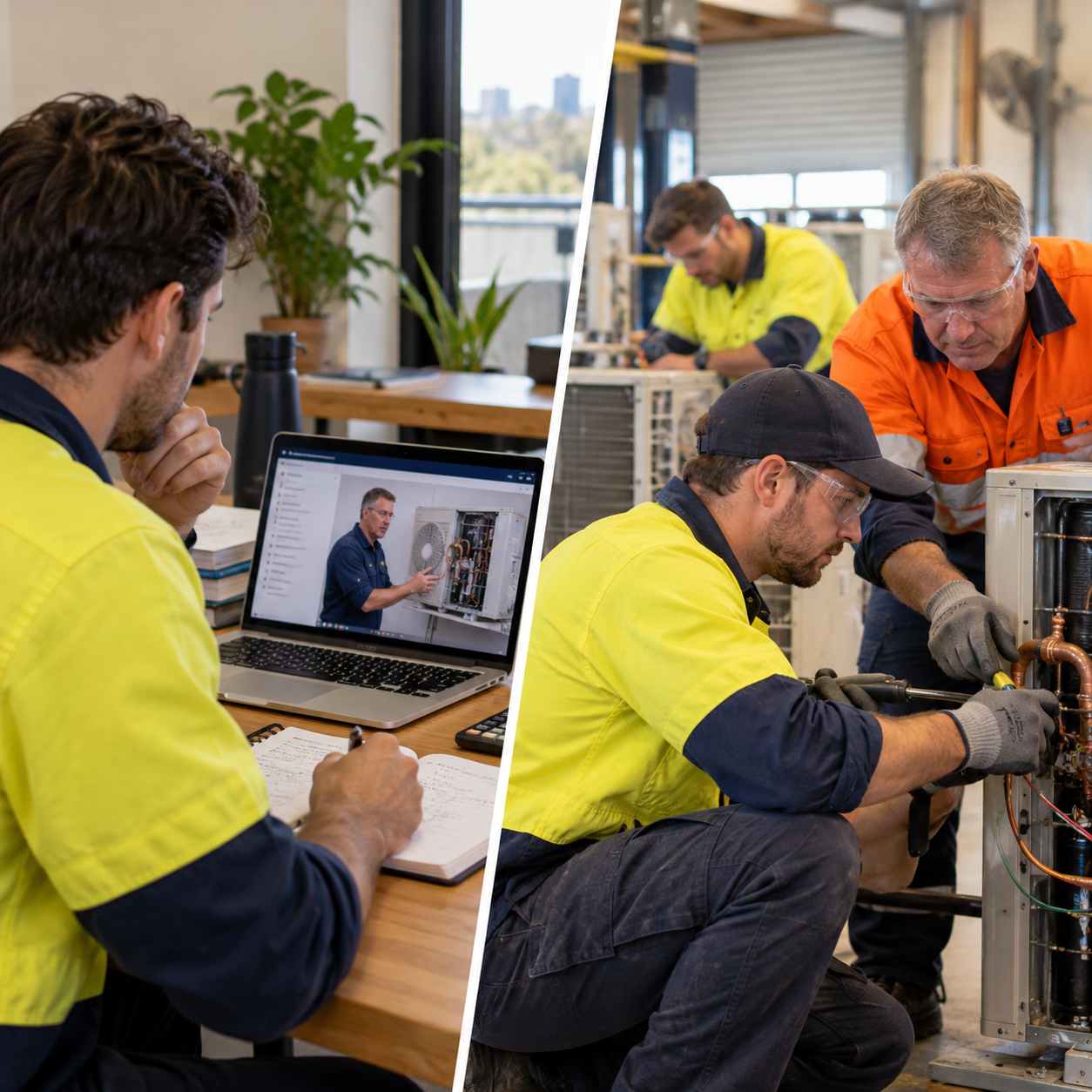
The legitimate model is blended delivery. That means the theory can be completed online, with structured modules, trainer support and tracked progress, while the practical side is completed in workshops, on-site assessments or supervised real-world tasks. This approach reflects how adults actually learn best – absorb the knowledge flexibly, then prove competence in person.
If a provider claims you can become fully trade-qualified in a hands-on field with no practical component at all, that is a red flag. If the practical requirements are clear, scheduled and aligned to the units of competency, that is far more credible.
For example, in refrigeration and air conditioning, compliance is not optional. The work involves safety, regulations, diagnostics, tools, testing and real equipment. Any serious pathway has to assess what you can do, not just what you can repeat.
Why online trade training gets a bad name
The problem is not online delivery. The problem is low-quality delivery.
Some providers oversell speed and undersell the work required. Others make broad promises without explaining accreditation, assessment conditions or licensing steps. That creates understandable distrust, especially among tradies who have seen too many people waste money on courses that do not move their career forward.
There is also confusion between short courses and full qualifications. A short online course might build a specific skill, but that does not automatically mean it leads to a trade outcome, licence or nationally recognised certification. People hear “online course” and assume all training sits in the same bucket. It does not.
A legitimate provider is transparent about what the course is, what it is not, how long it takes, what practical components are required and what outcome you can expect at the end. No smoke, no vague promises.
How to tell if online trade training is legitimate
You do not need to be an expert in vocational education to spot the difference. You just need to ask better questions.
First, check whether the qualification is nationally recognised and whether the provider is properly authorised to deliver it. If the answer is fuzzy, move on.
Second, ask how practical competency is assessed. If you are entering a trade where hands-on performance matters, there should be a clear process for workshops, practical demonstrations, workplace evidence or in-person assessments.
Third, ask what support exists while you study. Good online trade training is structured, not abandoned. You should know how progress is tracked, how trainers provide feedback and what happens if you fall behind.
Fourth, ask how the training fits with licensing or regulatory requirements in your state or trade. A qualification is important, but for many tradies, the real goal is legal work, better contracts and access to higher-paying roles.
Finally, look at whether the provider is speaking in outcomes or just hype. Real providers talk about compliance, units, assessments, timelines and student support. Weak providers talk mostly about easy money and fast certificates.
Online vs traditional apprenticeship: what actually matters?
This is where the conversation gets real. For many adults, the question is not whether online trade training is legitimate. It is whether it is a smarter pathway than the traditional route.
A traditional apprenticeship can be a strong option, especially for younger entrants who want full-time on-the-job development over several years. But for an experienced worker or mature-age student, that model can be painfully slow. Lower wages, less flexibility and a long completion timeline can keep people stuck in the same earning bracket for years.
A well-run blended training model changes that equation. You complete theory faster, fit study around work, attend practical sessions in a structured way and move toward qualification without pressing pause on your income. That is not cutting corners. That is cutting dead time.
Of course, speed only helps if standards stay intact. The right provider can compress the timeline because adult learners already bring work experience, discipline and context. The wrong provider just rushes content and hopes students do not notice the gaps.
That is the trade-off. Faster is valuable, but only when compliance and competency stay non-negotiable.
Who benefits most from online trade training?
Online trade training tends to suit people who already understand the value of time. If you are working full-time, supporting a family or trying to formalise skills you already use on the job, flexibility is not a luxury. It is the only way study happens.
This pathway also suits tradies who are tired of being blocked from better work because they lack papered qualifications. You might be capable on the tools, but if you cannot meet qualification or licensing requirements, your earning potential stays capped. That gap is expensive.
For those students, online delivery is not about convenience alone. It is about accelerating access to legitimate opportunities – higher rates, better job security, wider employment options and the ability to move toward licensing with confidence.
The real test: does it lead somewhere?
The strongest way to judge legitimacy is not the delivery method. It is the outcome.
Does the training move you closer to recognised certification? Does it help satisfy industry or licensing expectations? Does it include the practical work needed to perform safely and competently? Does it fit your life well enough that you are actually likely to finish?
Those questions matter more than whether the theory sits in a classroom or on a laptop.
For many Australian tradies, the old model is not more legitimate. It is just older. A structured online and practical blend can deliver the same recognised result in a way that works for real adult lives. That is why serious providers are not trying to replace standards. They are removing barriers.
Alpha Technical Training is built around that principle – flexible theory, real practical training, nationally recognised outcomes and support that keeps students moving toward qualification and licensing rather than stalling halfway.
If you are weighing up your options, be sceptical in the right way. Do not ask whether online automatically means low quality. Ask whether the provider can prove compliance, practical competency and a clear path to the result you actually want. When those boxes are ticked, online trade training is not only legitimate – it can be the move that gets your career unstuck.