A restricted job, a low pay ceiling and work you cannot legally sign off all lead back to the same problem: you may have the hands-on ability, but not the recognised credentials. This HVAC licensing guide Australia is built for tradies who want to turn existing experience into a compliant, better-paid air conditioning and refrigeration career without putting life on hold.
The path is not identical in every state and territory. What does stay consistent is the need for the right nationally recognised qualification, practical competency and approvals for the work you intend to carry out. Get those foundations right and you can move forward with confidence instead of losing jobs to fully qualified competitors.
What HVAC Licensing Means in Australia
In Australia, air conditioning and refrigeration work sits across several regulated areas. Installing, commissioning, repairing or servicing systems may involve refrigeration, electrical work, plumbing connections and building requirements. The permissions you need depend on the task, the equipment, your state or territory, and whether you are working as an employee or operating a business.
That is why there is no honest one-size-fits-all answer. A technician servicing split systems has different requirements from a contractor quoting, installing and signing off a commercial refrigeration job. Work involving refrigerant has national controls, while electrical and contractor requirements are administered at state or territory level.
The mistake is waiting until a customer, employer or regulator asks for paperwork. By then, you may have already missed the job or exposed yourself to unnecessary risk. The smarter move is to build your qualification pathway around the work you want to be doing in the next 12 to 24 months.
Start With the Right Trade Qualification
For most people entering or formalising their place in the industry, the central step is completing a nationally recognised air conditioning and refrigeration qualification. This is the credential that demonstrates you have been assessed against the skills required to work safely and competently across the trade.
A proper program is more than online theory and a certificate at the end. You need practical training that covers the work technicians are actually expected to perform: diagnosing faults, handling tools and test equipment, installing systems, brazing pipework, pressure testing, evacuating, charging, commissioning and following workplace safety procedures.
If you already have years on the tools, the question is not whether you need to start from zero. It is whether your experience can be matched to the required units and supported by evidence. Recognition of prior learning may be relevant for experienced workers, but it only works when your evidence is genuine, current and mapped properly. A few photos or a supervisor statement alone will rarely prove every competency.
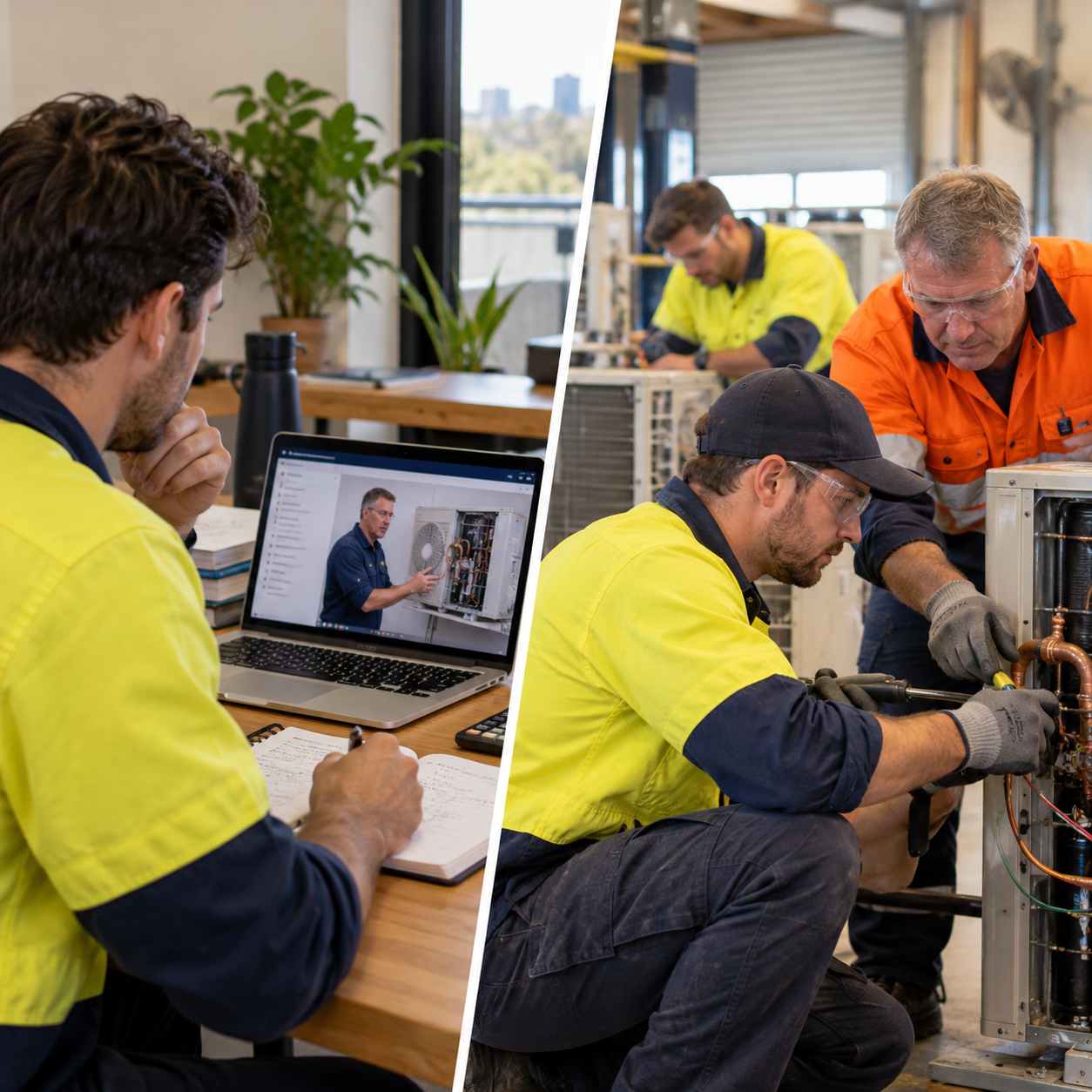
For people balancing a job, family and existing commitments, blended delivery can make the difference between progressing and staying stuck. Self-paced online theory keeps you moving through the knowledge component, while structured practical workshops give you the assessed hands-on experience that cannot be replaced by watching videos at home.
Why practical assessment matters
Air conditioning is a trade where shortcuts show up quickly. A poor flare, an incorrect pressure test, a missed leak or a system commissioned without proper checks can become an expensive callback, a safety issue or damage to your reputation.
Employers and customers value technicians who can diagnose systematically and complete work to standard, not people who only know the terminology. Practical assessment creates a record that you can perform the task under the right conditions. It protects the quality of your work and gives you far stronger footing when pursuing the approvals relevant to your role.
HVAC Licensing Guide Australia: Know the Approval Layers
The fastest route is not guessing which card or application comes first. Map the work you want to perform, then identify the approvals connected to that work. In broad terms, most air conditioning and refrigeration careers involve four layers:
- a nationally recognised trade qualification that verifies technical competence;
- refrigerant handling authorisation for work involving fluorocarbon refrigerants;
- electrical permissions where the job includes electrical installation, disconnection or prescribed electrical work; and
- state or territory contractor requirements if you intend to contract directly, supervise work or operate a business.
These layers are connected, but they are not interchangeable. Holding one does not automatically give you permission to perform every other type of work. For example, refrigerant handling credentials do not replace electrical authorisation, and a trade qualification does not automatically make someone eligible to operate as a contractor in every jurisdiction.
That distinction matters when planning your career. If your goal is employment with an established company, your first priority may be becoming fully qualified and job-ready. If your goal is to run your own air conditioning business, you need to think further ahead about the contractor, business and supervisory obligations that apply where you work.
Build Evidence While You Train
Your qualification is easier to progress when you treat evidence as part of the job, not an afterthought. Keep clear records of the tasks you perform, the equipment you work on, the tools you use and the supervision you receive. Where appropriate, retain job sheets, photos, work records and third-party reports.
Quality matters more than quantity. A folder full of unclear site photos will not demonstrate that you can fault-find, recover refrigerant, commission a system or follow safe isolation procedures. Strong evidence shows the task, your role in it and the standard achieved.
A good training provider will help you understand what is required, track your progress through a learning management system and identify gaps early. That structure is valuable for working adults because it replaces the uncertainty of trying to piece together a qualification around long workdays.
Choose Training That Fits the Real Job
Traditional apprenticeships remain a valid pathway, especially for people at the start of their career who have an employer able to provide broad, consistent supervision. But they are not the only route for adults with industry exposure, transferable skills or a clear need to qualify sooner.
The trade-off is straightforward. A fast-tracked pathway demands discipline. You still need to complete the same accredited requirements, demonstrate competence and attend practical training. It is faster because it is structured around your existing work and availability, not because standards are reduced.
Look for a provider that can clearly explain the qualification outcome, practical attendance requirements, assessment process and the support available when you hit a roadblock. Monthly practical workshops led by active industry professionals can be particularly useful because they keep learning connected to current site expectations.
At Alpha Technical Training, the focus is on helping working tradies progress through nationally recognised air conditioning and refrigeration training with flexible theory, practical support and visible progress. That matters when your goal is not simply to study, but to move into work that carries greater responsibility and earning potential.
Avoid the Delays That Hold Tradies Back
Most delayed outcomes come from poor planning, not a lack of ability. People enrol in a course that does not match their end goal, underestimate practical attendance requirements, fail to gather workplace evidence, or assume the rules are identical across borders.
Before committing, be clear on three things: the type of work you want to perform, the state or territory where you will perform it, and whether you want to work for an employer or contract in your own name. Those answers shape the training and approval pathway you should follow.
Do not let uncertainty become another year of waiting. The right qualification pathway turns real experience into recognised capability, gives you a clear record of progress and puts you in a stronger position to take on the work you are already capable of growing into.