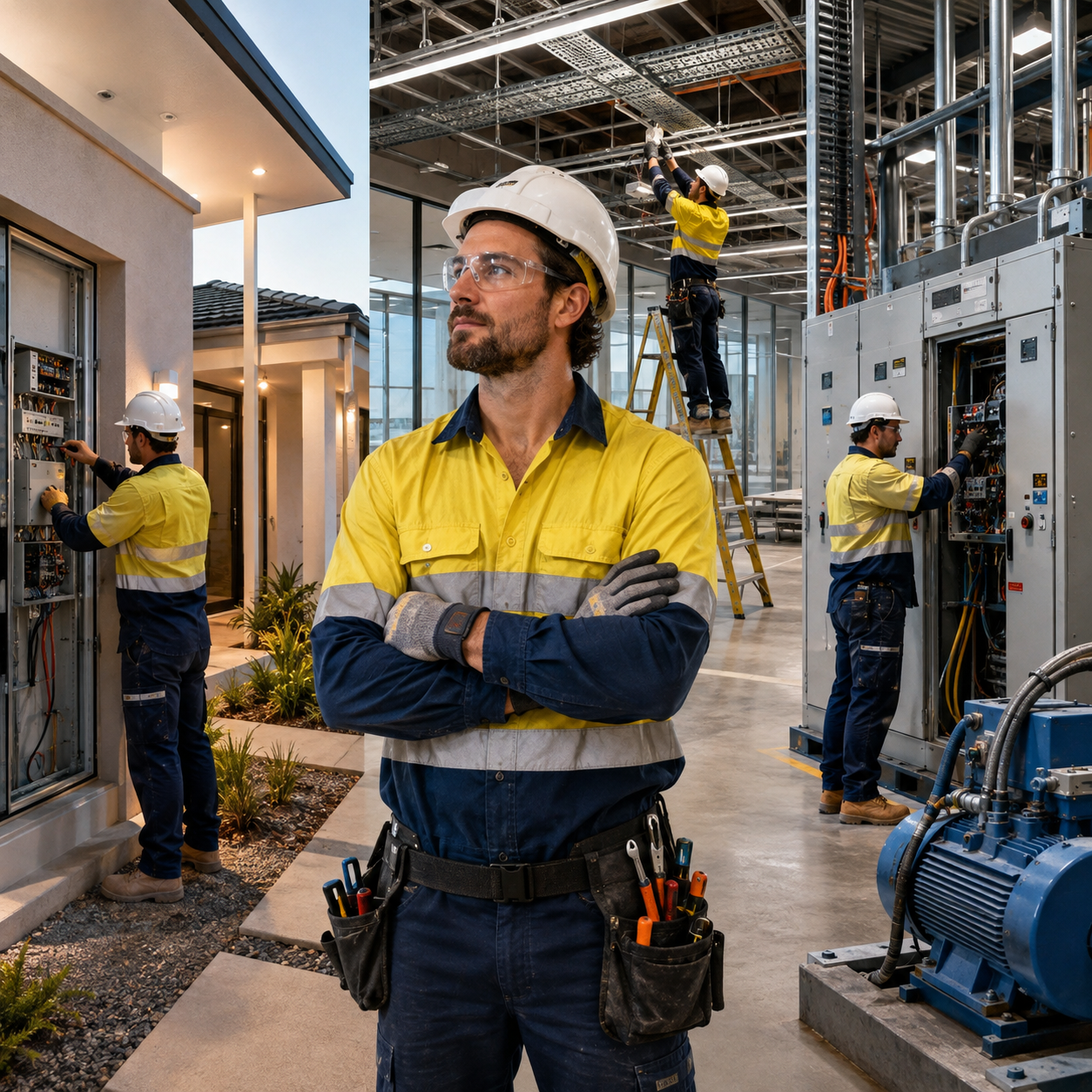
Residential, commercial or industrial — which should you choose?
There is no single best electrical career path in Australia.
Residential electrical work often suits people who enjoy
smaller projects, different job sites, direct customer contact, fault-finding
in homes and the possibility of eventually operating an electrical contracting
business.
Commercial electrical work can be a strong middle ground,
involving offices, hospitals, schools, warehouses, shopping centres and other
larger buildings. It can provide exposure to larger electrical systems,
detailed drawings and major construction projects.
Industrial electrical work often involves machinery, motors,
control circuits, sensors, PLCs, instrumentation and complex fault-finding.
Depending on the employer, it can also involve shift work, shutdowns,
remote locations and specialised site requirements.
Industrial does not automatically mean higher pay, and residential does not
automatically mean easier or less-skilled work. Your actual earnings and career
opportunities depend on your employer, experience, location, roster, overtime,
allowances, enterprise agreement, competencies and specialisation.
If you are an apprentice, the quality and breadth of your training may matter more
than the label attached to the employer.
Residential vs commercial vs industrial electrician: what is actually different?
When people search for the best electrical career path in Australia,
residential, commercial and industrial electrical work are often described as if
they are three completely separate trades.
They are not.
Australia’s national electrician trade qualification is currently
UEE30820 Certificate III in Electrotechnology Electrician.
According to
training.gov.au,
the qualification covers competencies associated with selecting, installing,
setting up, testing, fault-finding, repairing and maintaining electrical systems
and equipment.
Jobs and Skills Australia describes electricians as working on electrical
systems for domestic, commercial and industrial purposes, including installing
equipment, interpreting drawings, testing circuits, diagnosing faults and
maintaining electrical systems.
You can review the official occupation profile through
Jobs and Skills Australia.
The underlying electrical trade is shared, but the type of equipment,
working environment, fault-finding and career opportunities can become
dramatically different.
Residential
Houses, apartments, renovations, domestic switchboards, lighting,
power, service work and customer-facing jobs.
Good fit: variety, customer contact, small projects
and future contracting.
Commercial
Offices, hospitals, retail centres, schools, warehouses, apartment
developments and large building projects.
Good fit: large projects, drawings, structured sites
and larger electrical installations.
Industrial
Manufacturing plants, processing facilities, mines, utilities,
machinery, motors, controls, PLCs and instrumentation.
Good fit: fault-finding, machinery, automation and
technically complex systems.
What does a residential electrician do in Australia?
A residential electrician in Australia primarily works
in houses, apartments and other domestic environments.
For apprentices, residential electrical work can provide intensive
exposure to the fundamentals of electrical installation.
Typical work may include:
- wiring new houses;
- installing lighting and power circuits;
- installing or upgrading switchboards;
- renovation work;
- installing fans and appliances;
- electrical testing;
- fault-finding;
- smoke alarm work;
- outdoor electrical installations; and
- maintenance and service calls.
Residential electrical work can involve serious fault-finding
Residential work is sometimes described as the simplest branch of the trade,
but that can be misleading.
A new-house installation may be relatively systematic. Residential service
work is different.
You may arrive at a house that has been modified repeatedly over several
decades and need to work out why a circuit is tripping, why equipment is
behaving unexpectedly or what previous alterations have been made.
That can develop strong diagnostic ability.
What is the residential work environment like?
Residential electricians commonly move between different locations.
Some businesses work almost entirely on new homes, while others perform
service, maintenance and renovation work.
The environment may involve roof spaces, insulation, under-floor areas,
ladders, outdoor work and confined spaces.
Residential electricians also tend to interact directly with customers
more frequently than many industrial electricians.
That means communication skills matter.
If your long-term goal is to operate your own electrical contracting
business, understanding quoting, scheduling, customer service and residential
fault-finding can be extremely useful.
to operate an electrical contracting business can involve separate requirements.
Check the rules in your state or territory.
What does a commercial electrician do in Australia?
A commercial electrician in Australia generally works
on larger buildings and facilities rather than individual houses.
Work environments can include:
- office buildings;
- shopping centres;
- schools;
- hospitals;
- hotels;
- warehouses;
- government facilities;
- large apartment developments; and
- major construction projects.
Commercial electricians may work with larger switchboards and distribution
systems, long cable runs, emergency lighting, communications infrastructure
and building services.
Commercial sites can be highly structured
Large commercial construction projects can operate very differently from
domestic jobs.
Electricians may work from detailed construction drawings, coordinate with
multiple trades, follow staged project schedules and complete work under
highly organised site-management systems.
On a very large project, you may spend considerably longer on one site than
a residential electrician would spend at a typical customer property.
Is commercial electrical work more technical than residential?
Sometimes, but the comparison is not straightforward.
Commercial projects may involve larger installations and more extensive
electrical documentation.
However, a highly experienced residential service electrician can face
extremely challenging diagnostic problems in unfamiliar installations.
The difficulty is different rather than automatically higher or lower.
What does an industrial electrician do in Australia?
An industrial electrician in Australia generally works
around machinery, equipment and industrial processes rather than focusing
primarily on lighting and general power in buildings.
Industrial workplaces can include:
- manufacturing facilities;
- food-processing plants;
- water and wastewater facilities;
- mines and quarries;
- processing plants;
- energy infrastructure;
- automated warehouses; and
- heavy industrial facilities.
Typical industrial electrical systems may include:
- three-phase motors;
- motor-control circuits;
- contactors and relays;
- variable speed drives;
- proximity and process sensors;
- programmable logic controllers;
- instrumentation;
- industrial control panels; and
- automated production equipment.
Why industrial electricians spend so much time fault-finding
When equipment stops in a manufacturing or processing environment,
production may also stop.
An industrial electrician may need to determine whether a fault is caused
by the electrical supply, a motor, control circuit, sensor, variable speed
drive, PLC signal, safety circuit or another part of the process.
This can make industrial maintenance highly analytical.
The UEE30820 training package contains elective units involving PLCs,
industrial control systems, instrumentation and hazardous-area work.
However, those are electives and specialist competencies.
completed every PLC, instrumentation, hazardous-area or specialist
industrial competency.
Residential vs commercial vs industrial electrician: side-by-side comparison
| Factor | Residential | Commercial | Industrial |
|---|---|---|---|
| Typical workplace | Houses, apartments and domestic developments | Offices, retail, schools, hospitals and major buildings | Factories, plants, mines, utilities and processing facilities |
| Common work | Lighting, power, switchboards, renovations and domestic faults | Large installations, distribution, lighting and building systems | Motors, machinery, controls, PLCs and plant maintenance |
| Customer interaction | Often high | Moderate | Often lower |
| Fault-finding | Common in service work | Common in maintenance | Often central to the job |
| Project scale | Usually smaller | Medium to very large | Medium to extremely large |
| Local travel | Often frequent | Depends on project | May remain at one facility or involve remote travel |
| Shift work | Less common | Possible | More common in continuous operations |
| Automation exposure | Usually limited | Increasing | Potentially extensive |
| Self-employment pathway | Strong | Strong | Possible but often employer or site based |
| Common specialisations | Solar, batteries, smart homes, service work | Building controls, communications, large distribution | PLCs, instrumentation, automation, hazardous areas |
Which type of electrical work is the hardest?
A common debate is whether industrial electrical work is harder than
residential or commercial electrical work.
Industrial work can become highly technical because electricians may need
to understand machinery, process controls, instrumentation and automation.
But that does not mean every industrial electrician performs more difficult
work than every residential electrician.
A residential service electrician diagnosing an altered 50-year-old
installation is solving a different type of problem.
A commercial electrician coordinating a large installation from detailed
drawings and working across major distribution systems faces another
kind of complexity.
electrical problem do I enjoy solving?”
Which electrical sector pays the most in Australia?
Searches for
industrial electrician salary Australia,
commercial electrician salary Australia and
residential electrician salary Australia
often produce very different numbers.
Those figures need context.
There is no universal Australian wage that applies simply because someone
identifies as a residential, commercial or industrial electrician.
Jobs and Skills Australia’s electrician occupation profile reports national
earnings information for electricians broadly rather than neatly dividing
workers into these three sectors.
Check the latest figures through
Jobs and Skills Australia.
Your actual earnings can depend on:
- experience;
- classification;
- employer;
- location;
- industry;
- enterprise agreement;
- award coverage;
- shift penalties;
- overtime;
- allowances;
- remote work; and
- specialist competencies.
Where the
Electrical, Electronic and Communications Contracting Award
applies, overtime, shiftwork and other provisions can significantly affect
total earnings.
Why industrial electricians can sometimes earn more
Industrial facilities are more likely than normal residential construction
to operate around the clock.
That can create opportunities for night shifts, weekend work, overtime,
shutdowns, on-call work and location-based allowances.
That does not mean industrial work automatically pays more.
It may simply create more opportunities for additional payments — sometimes
in exchange for a less predictable lifestyle.
Which electrical sector has the best lifestyle?
The employer and roster often matter more than the sector.
Residential lifestyle
Residential electrical work commonly operates during normal daytime hours,
particularly in new construction.
Service businesses may also offer emergency or after-hours work.
Commercial lifestyle
Commercial construction often involves early starts and structured site
hours.
Large projects may require overtime as deadlines approach.
Industrial lifestyle
Industrial maintenance can provide the advantage of working at one site
rather than travelling between customer jobs.
The trade-off is that factories, processing plants, utilities and mining
operations may run continuously.
That can mean:
- rotating shifts;
- night work;
- weekend work;
- shutdowns;
- on-call arrangements; and
- FIFO or remote rosters in some industries.
Consider what the working hours actually mean for your family,
health, travel and long-term priorities.
Which sector is best for an electrical apprentice?
If you are comparing options for an
electrician apprenticeship in Australia,
the quality of the apprenticeship should usually come before the sector label.
A high-quality residential apprenticeship can be better than a poor industrial
apprenticeship where you spend years performing a narrow repetitive task.
Likewise, a strong industrial apprenticeship can provide broad exposure to
electrical installation, maintenance, motors, controls and fault-finding.
Ask prospective employers:
- What work will apprentices actually perform?
- Will I rotate through different types of work?
- Will I learn testing and fault-finding?
- Will I receive proper supervision?
- Do apprentices get experience with switchboards?
- Will I work on both new and existing installations?
- Will experienced tradespeople actually teach me?
Those questions can tell you far more than the words “residential”,
“commercial” or “industrial” in a job advertisement.
If I start in residential, will I be stuck there forever?
No.
Starting in residential electrical work does not permanently lock you into
the residential sector.
The challenge is usually experience rather than the basic trade qualification.
For example, imagine you complete your apprenticeship mainly wiring houses
and later apply for an industrial maintenance job requiring experience with
PLCs, variable speed drives and industrial motors.
Your electrician licence remains valuable, but the employer may prefer someone
who already understands that equipment.
You may therefore need additional training and workplace exposure.
A common progression could look like:
Your Electrical Career Can Evolve
Residential
Domestic installation → service work → solar/batteries →
contracting/business
Commercial
Commercial construction → service → supervision →
estimating/project management
Industrial
Industrial maintenance → motors/controls → PLCs →
instrumentation/automation
regulator-required authorisations as your career develops
Commercial vs industrial electrician: which has better long-term opportunities?
Both can lead to strong careers.
Commercial electricians may progress toward:
- site supervision;
- estimating;
- project management;
- commissioning;
- service management; and
- electrical contracting.
Industrial electricians may progress toward:
- automation;
- instrumentation;
- PLC systems;
- process control;
- maintenance supervision;
- reliability roles;
- commissioning; and
- specialist plant maintenance.
If you are particularly interested in controls and automation,
industrial electrical work can provide a strong foundation.
What about mining, hazardous areas and high-voltage electrical work?
This is where an important distinction needs to be made.
Holding an unrestricted electrician licence should not be interpreted
as meaning you are automatically qualified or authorised to perform
every specialist electrical task in every Australian workplace.
Hazardous areas
Industrial facilities can contain hazardous areas where explosive gases,
vapours or combustible dusts may be present.
Specialist competency requirements can apply to work involving
explosion-protected electrical equipment.
Queensland’s Electrical Safety Office provides guidance on
hazardous-area electrical installations.
The UEE training package also contains specialist hazardous-area
competencies.
Mining electrical work
A mining electrician may need additional site-specific
competencies, inductions, medical assessments, employer requirements and
equipment experience.
Completing Certificate III alone should not be viewed as a guarantee of
immediate entry into a high-paying FIFO mining role.
High voltage and other specialist work
High-voltage, instrumentation, hazardous-area and other specialist
electrical activities may involve additional competencies, site
authorisations or regulatory requirements depending on the work and
jurisdiction.
authorises every specialist activity.
Check the requirements for the actual work, employer and jurisdiction.
What if I want to become a PLC or instrumentation electrician?
If industrial automation interests you, you may eventually move toward
becoming a PLC electrician or
instrumentation electrician.
These roles can involve:
- PLC diagnostics;
- control logic;
- instrumentation;
- process sensors;
- control loops;
- motor control;
- variable speed drives;
- industrial communications; and
- commissioning.
Additional qualifications and units exist within the Australian
electrotechnology training system for instrumentation and control.
Search current qualifications and units through
training.gov.au.
Which electrical career suits you?
Choose based on the type of environment and problems you actually
enjoy rather than assuming one sector is automatically better.
Choose Residential If…
- You enjoy changing locations.
- You like interacting with customers.
- You enjoy smaller jobs with visible results.
- You like residential fault-finding.
- You may want to run your own contracting business.
Choose Commercial If…
- You like large organised projects.
- You enjoy reading detailed drawings.
- You prefer construction environments.
- You like working around multiple trades.
- You want exposure to larger electrical installations.
Choose Industrial If…
- You enjoy fault-finding.
- You are interested in machinery.
- You want to learn PLCs and automation.
- You enjoy understanding how systems interact.
- You can tolerate shift work or industrial environments.
Your Certificate III is not automatically your electrician licence
Regardless of whether you choose residential, commercial or industrial
electrical work, this distinction is critical.
UEE30820 Certificate III in Electrotechnology Electrician
is the national trade qualification.
Electrical licensing, however, is administered by Australian states and
territories.
Training.gov.au notes that competency development within the qualification
is subject to licensing regulations and that unrestricted electrician
licensing commonly requires an apprenticeship or applicable recognised
pathway.
New South Wales explains that electrical wiring work requires the
appropriate electrical licence or certificate whether the work is
residential, commercial or industrial.
You can review NSW requirements through
Service NSW.
Victoria similarly has specific requirements for progressing from
apprenticeship training to an A Grade electrician licence.
See
Energy Safe Victoria.
Completing UEE30820 does not by itself automatically grant authority
to perform unrestricted electrical work.
Already experienced? Electrical RPL may recognise some of what you know
The residential-versus-commercial-versus-industrial question becomes
particularly relevant for people who already have significant electrical
industry experience.
You may have:
- worked as an electrical trade assistant;
- previously completed part of an apprenticeship;
- worked in industrial maintenance;
- completed relevant electrotechnology units;
- worked around control systems or instrumentation;
- gained commercial installation experience; or
- qualified overseas.
In those circumstances, a legitimate
electrical RPL Australia assessment may identify
competencies that can be recognised.
ASQA explains that
Recognition of Prior Learning
assesses skills and knowledge acquired through previous work, training
and other learning against qualification requirements.
Credit transfer can separately recognise eligible units that have already
been formally completed.
It does not automatically provide an electrician licence or remove
mandatory regulatory requirements.
Industrial experience can be useful, but it must match the competency
Years of industrial exposure can provide strong evidence for some
electrical competencies.
But simply working around machinery does not automatically establish
competency across the entire Certificate III.
A qualified assessor must determine whether your evidence satisfies the
relevant competency requirements.
Red flags when considering electrician RPL
Be cautious if a provider suggests that you can:
- automatically receive UEE30820 because you have worked in the industry;
- obtain an unrestricted electrician licence simply through RPL;
- skip all practical assessment;
- avoid mandatory supervised workplace requirements;
- bypass an apprenticeship where one is legally required;
- ignore the requirements of your state electrical regulator; or
- complete a guaranteed licensing pathway within the same fixed timeframe regardless of your experience.
Before paying an RPL provider:
-
Verify the RTO on
training.gov.au. - Confirm that UEE30820 is currently on the RTO’s scope.
- Ask exactly which units could potentially be assessed by RPL.
- Ask what practical assessments and workplace evidence will be required.
- Ask what gap training is likely to remain.
-
Confirm the proposed pathway with the electrical regulator in the
jurisdiction where you want to become licensed.
So, should you choose residential, commercial or industrial electrical work?
If you like customers, variety, domestic fault-finding and the idea of
eventually operating a local electrical business, residential work may
suit you.
If you enjoy large projects, detailed drawings, structured construction
environments and substantial building installations, commercial work
may be the better fit.
If you enjoy machinery, troubleshooting, motors, PLCs, automation and
understanding how complex systems interact, industrial electrical work
may be where you thrive.
But if you are just beginning your apprenticeship, do not assume you need
to choose your lifelong specialisation immediately.
Electrical careers evolve.
You might begin in residential construction, move into commercial service,
then eventually enter industrial maintenance.
Or you might discover that residential service work is exactly what you
enjoy and build a successful career around it.
The best electricians are not necessarily those who work in the sector
with the most impressive title.
They are electricians who develop strong fundamentals, test correctly,
fault-find systematically, work safely and keep learning.
Already have electrical industry experience?
If you already have substantial residential, commercial or industrial
electrical experience, you may not need to repeat training for every
competency you can already genuinely demonstrate.
A properly conducted RPL, credit-transfer and gap-training assessment may
identify existing competencies and determine what remains.
The goal is not to bypass the electrical trade or licensing system.
It is to recognise genuine existing competency while completing every
remaining training, assessment, supervision and licensing requirement.
This article provides general career, vocational education and electrical
licensing information for Australia. It is not legal advice, employment
advice, training advice or licensing advice.
Electrical licensing requirements vary between Australian states and
territories and may change.
Specialist activities including hazardous-area work, high-voltage work,
instrumentation, mining and other industrial electrical activities may
involve additional competencies, site requirements, employer requirements
or regulatory authorisations.
UEE30820 Certificate III in Electrotechnology Electrician does not by
itself automatically grant an unrestricted Australian electrical licence.
Before choosing an apprenticeship, RPL or gap-training pathway, confirm
the current qualification requirements on training.gov.au, verify the
RTO’s scope and check your proposed licensing pathway with the relevant
state or territory electrical regulator.