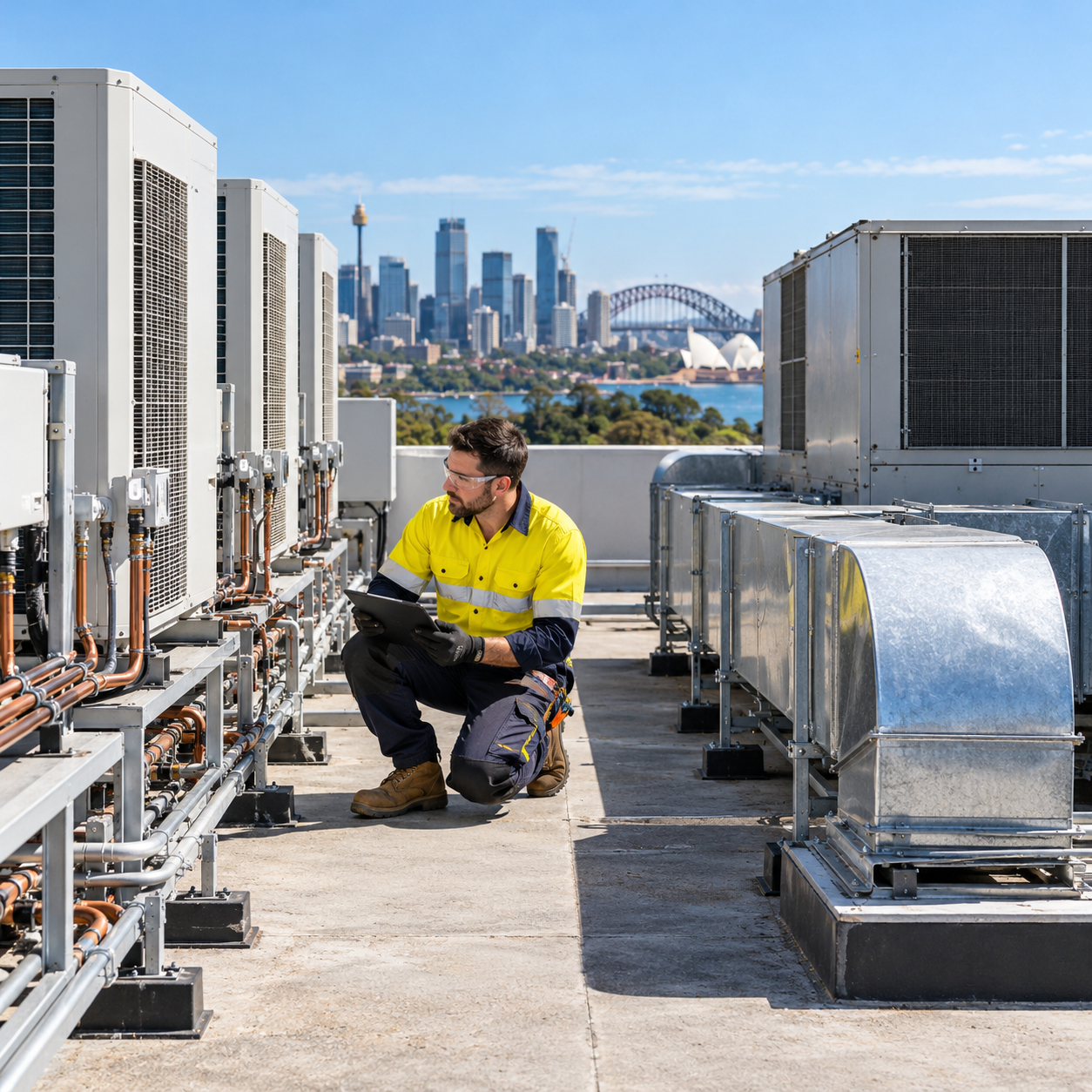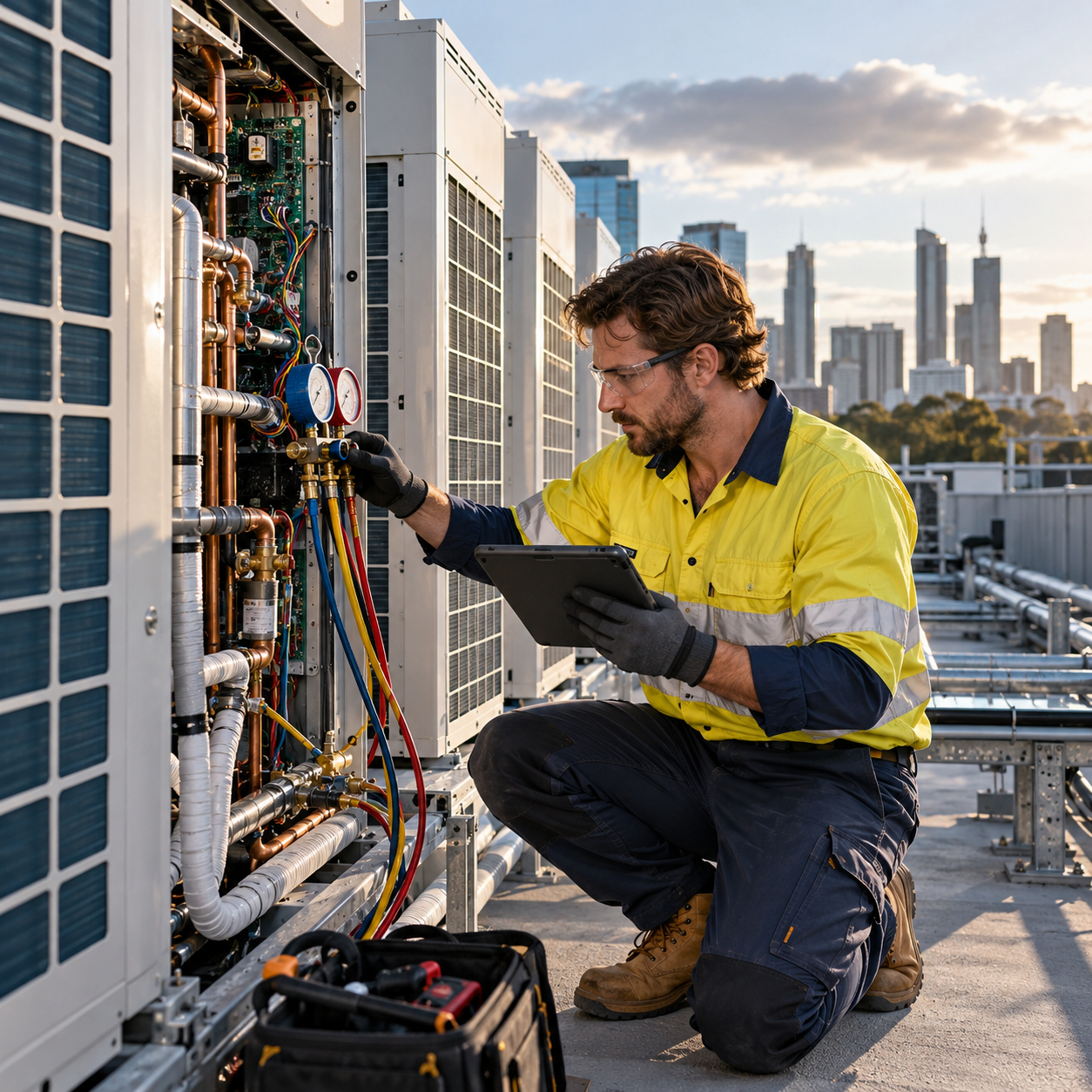
A VRV system can look perfect at rough-in and still fail to perform properly once the building is occupied. One incorrect address, an overlooked branch selector setting or incomplete test sequence can create callbacks, unhappy clients and hours of fault-finding. VRV commissioning training gives technicians a disciplined process for taking a complex variable refrigerant volume system from installed equipment to verified operation.
This is not training for people who want more theory without a practical result. It is for refrigeration and air conditioning technicians who want to understand what the controller is telling them, identify faults faster and hand over systems with confidence. On large commercial jobs, those skills separate the technician who follows instructions from the technician the site team relies on.
Why VRV commissioning is a higher-value skill
Split systems are familiar territory for many technicians. VRV systems are different. They combine multiple indoor units, control networks, refrigerant pipework, branch components and often several zones with different operating demands. The equipment must not only run – it must communicate, respond and operate within design intent.
That means commissioning cannot be treated as a final switch-on. It is a structured verification process. You need to confirm installation conditions, power supply requirements, control wiring, addressing, test operation and fault codes before the job reaches handover.
A rushed process creates predictable problems. Indoor units may not appear on the network. A system may return an intermittent communication fault. A zone may heat while another is expected to cool. The technician then has to revisit work that should have been resolved before the ceiling is closed or the client moves in.
For experienced tradies, better commissioning capability is a direct way to become more useful on commercial and high-specification projects. It supports cleaner handovers, fewer return visits and stronger confidence when dealing with builders, supervisors and facility managers.
What VRV commissioning training should teach
The right training should make the process clearer, not bury it under manuals. You should leave knowing the order of work, the reason behind each check and the evidence that tells you whether the system is ready.
Start with installation readiness
Commissioning begins before the controller is powered up. Technicians need to recognise whether the installation is genuinely ready for testing. That includes checking pipework completion, evacuation and pressure-test records, electrical connections, communication wiring and correct component selection.
This step matters because many apparent commissioning faults are installation faults in disguise. If the physical system is incomplete or incorrectly configured, changing controller settings will not solve the problem. Good training teaches you to check the fundamentals first, rather than losing time chasing error codes.
Understand system configuration and addressing
VRV systems rely on accurate communication between outdoor units, indoor units and controls. Addressing, auto-address functions and controller setup can vary depending on the system design and installed accessories.
A capable technician needs to know what should happen during setup, where to verify the outcome and how to recognise an abnormal result. This is where practical instruction has real value. Reading a sequence is useful. Watching it applied, then completing it yourself with guidance, builds judgement that carries onto site.
Run test operation with purpose
A test run is not simply confirmation that air is coming from a grille. It is the point where system behaviour is checked against expected operation. Technicians need to interpret operating status, identify communication issues, confirm unit response and understand when a fault requires further investigation rather than a quick reset.
Training should cover the logic behind test operation. What does the system check automatically? What still requires technician verification? Which indications are normal during start-up, and which point to a genuine issue? Those distinctions prevent both missed defects and unnecessary delays.
Diagnose faults without guessing
Fault codes are useful, but they are not a complete diagnosis. A code points you towards an area of the system. It does not replace methodical checks of wiring, configuration, power, sensors, valves or communications.
Effective VRV commissioning training develops a repeatable diagnostic habit: read the fault information, verify the likely cause, test the relevant components and confirm the repair through a controlled restart. This approach is faster than replacing parts on assumption, and it protects your reputation when the fault is more complex than it first appears.
The difference between course knowledge and site capability
Technicians often know the broad commissioning sequence but struggle when site conditions are not ideal. The plans may have changed. Controls may be incomplete. Another trade may have affected cabling. The building may have limited access hours or tenants already working nearby.
That is why hands-on training matters. The best learning environment allows you to work through the sequence, make decisions, identify errors and ask questions while an industry professional explains the consequence of each step. You are not just memorising buttons on a controller. You are learning how to think through a system.
Online theory still has a place. It helps technicians prepare, revise product information and learn the terminology before practical work. But theory alone has limits. Commissioning is physical, diagnostic and procedural. The strongest pathway combines structured self-paced learning with practical workshop time where the process is performed properly.
For technicians balancing work and family commitments, this blended approach also makes training achievable. You can complete preparation around existing jobs, then use face-to-face time to focus on the tasks that are difficult to learn from a screen.
Where technicians lose time on VRV jobs
Most expensive delays come from a small number of avoidable gaps. The first is starting the commissioning sequence before installation checks are complete. The second is treating communication faults as an isolated controls issue when the cause may be power supply, wiring polarity, termination or configuration. The third is handing over without proving that each unit and control function responds as intended.
There is also a documentation issue. On a complex system, clear records of checks, settings and test results make future service work far easier. They help the next technician understand what was commissioned, what was observed and where to begin if the system later reports a fault.
The answer is not to turn every job into paperwork. It is to use a consistent process that prevents missed steps. Skilled technicians move quickly because they are systematic, not because they skip verification.
Choosing training that helps on real projects
Before committing to a course, look beyond the course name. Ask whether the program includes actual system commissioning tasks, fault diagnosis and controller operation. Check that practical delivery is led by trainers with current industry experience, not only classroom knowledge.
It also pays to consider whether the learning format fits your working life. A course that requires long periods away from work may be difficult to complete. Flexible online theory and scheduled practical workshops can reduce disruption while keeping the practical standard high.
At Alpha Technical Training, Daikin VRV System Short Courses are designed around practical capability. The focus is on helping technicians understand system operation, follow a disciplined commissioning process and build confidence with the checks that matter on site.
Turn commissioning into a professional advantage
VRV work rewards technicians who are prepared. Complex systems do not leave much room for guesswork, and clients notice the difference between a rough start-up and a controlled handover. When you understand the sequence, can interpret system feedback and know how to isolate faults, you become easier to trust on more demanding jobs.
The goal is not to make commissioning complicated. It is to make your process reliable enough that the next VRV system is not a gamble. Build the skill properly, apply it methodically and let your site results speak for you.